Three one-on-one meeting templates, and how to put them into action
.png)

One-on-one (1:1) meetings are great for keeping your focus where it belongs: on the individuals you hired and want to nurture toward success. Getting away from the chaos and connecting directly is an effective way to gather useful feedback, keep team members aligned, and find out about problems before they get out of hand.
Of course, like any type of meeting, a 1:1 can also be a futile waste of time and resources. In many of those cases, the core issue is a lack of structure. When HR and managers improvise, employees don’t know what to expect, and key questions fall through the cracks. And as for action items, they rarely get documented or followed up on.
To make matters worse, many HR teams don’t realize when their company’s 1:1s need improvement. While 71% of managers believe they give constructive feedback, only 37% of individual contributors agree.*
This guide gives HR managers the tools to close that gap. By following the free one-on-one meeting templates provided and asking the questions that truly matter, you can make every 1:1 a source of insights and growth, instead of just another calendar appointment.
*Leapsome’s Workforce Trends Report, 2024
What a one-on-one meeting typically looks like
A 1:1 meeting is a conversation between two people, rather than a group discussion. These meetings are usually between managers and direct reports, but they can also involve two employees at the same level (peer-to-peer 1:1s) or an employee and their manager’s manager (skip-level 1:1s).
Three downloadable one-on-one meeting templates to keep employees and managers on track
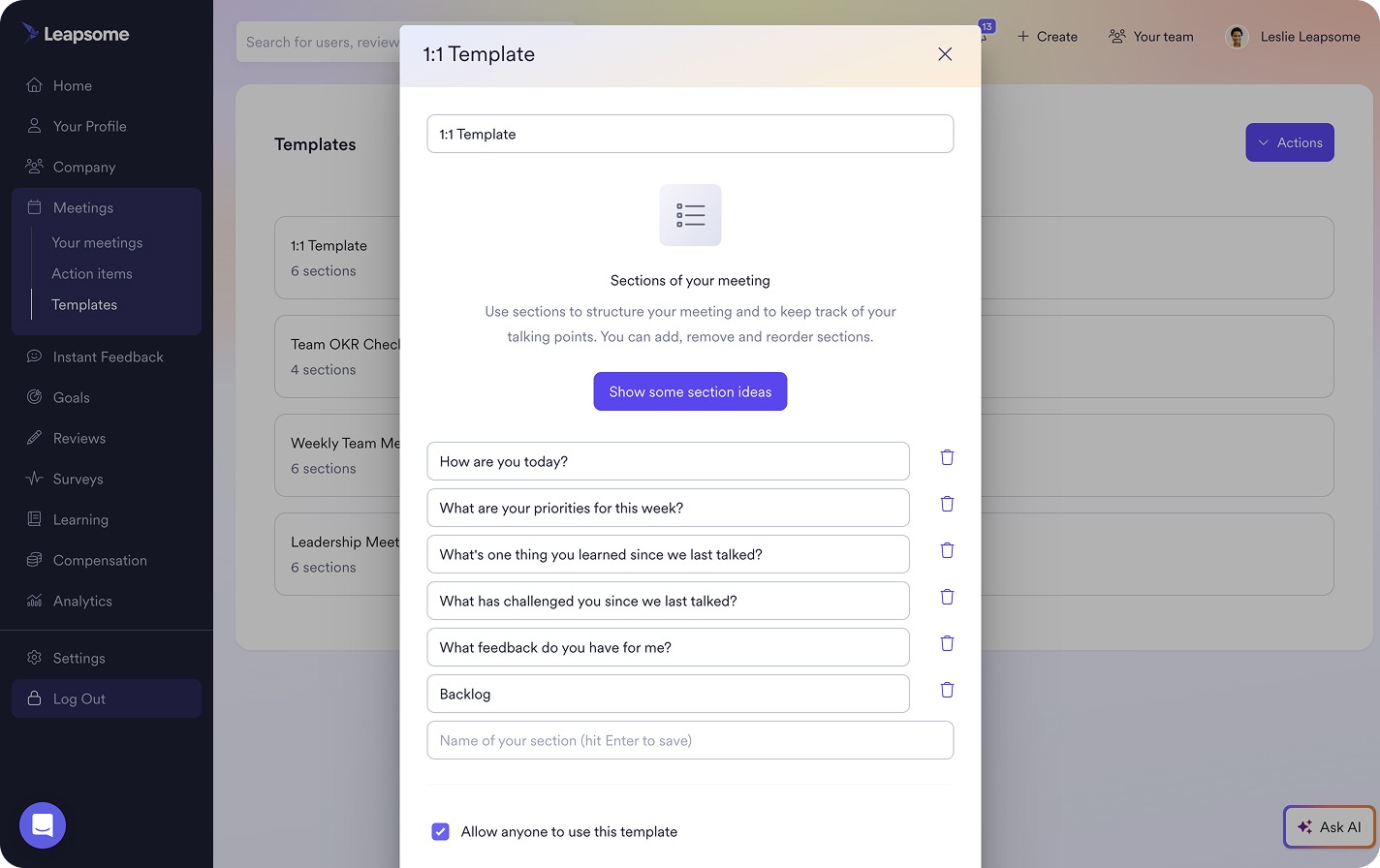
Following a template is a low-effort, high-reward way to keep 1:1s productive. The hard part is creating that structure in the first place. Fortunately, we’ve started that task for you.
These 1-on-1 meeting templates for common scenarios give every conversation a clear direction and keep it focused on the core goal. Feel free to adapt each one to your company’s needs.
Weekly check-in 1:1 template
Regular check-ins are a simple but effective way to gauge each employee’s current workload, performance, and pain points. They give team members the opportunity to air concerns or ask for extra resources and support.
Here’s a weekly manager check-in template that ticks all the boxes.
[Date]
[Manager’s name]
[Employee’s name]
Meeting type: Weekly check-in
Last meeting’s action items catch-up:
Recap of the past week:
Priorities for this week:
Blockers and challenges:
Support requests:
Feedback for manager:
Action items
| [Manager's name] | [Employee's name] |
| [action item] | [action item] |
| ... | ... |
Next meeting date:
✅ Make employee check-ins effortless
Use our template to prepare for check-ins and keep clear records.
👉 Download the template now
Onboarding session 1:1 template
A new employee’s first 1:1 sets the tone for the rest of the working relationship. Here’s a framework for getting it right.
[Date]
[Manager’s name]
[Employee’s name]
Meeting type: Onboarding
Questions:
- What excites you about this role?
- What feels the most daunting?
- Which management style suits you best?
- How do you prefer to receive feedback?
- Are there any tools or resources you still need?
- Is there anything you’d like to know about the team, company culture, or role?
- Do you have any feedback to help us improve our hiring process?
Action items
| [Manager's name] | [Employee's name] |
| [action item] | [action item] |
| ... | ... |
Next meeting date:
🏁Start new hires off right
Set employees up for success with a structured template for onboarding chats.
👉 Download the template now
Performance review 1:1 template
Whether an employee is performing well or not, a respectful conversation about their job performance and objectives is the best way to understand what’s going on and how to move forward. Here’s a performance meeting agenda you can use.
[Date]
[Manager’s name]
[Employee’s name]
Meeting type: Performance review
Goals set in previous review:
Progress on goals:
Areas for improvement:
Proposed performance objectives:
Feedback for employee:
Feedback for manager:
Action items
| [Manager's name] | [Employee's name] |
| [action item] | [action item] |
| ... | ... |
Next performance review:
📜 Focus on performance, not paperwork
Use a structured performance review process to keep them goal-oriented and productive.
👉 Download the template now
What makes a 1:1 the Swiss Army knife of meetings
No matter what the meeting is for, a well-conducted 1:1 fosters better working relationships between employees and managers, because it builds trust and creates space for open communication. This type of meeting can improve employee engagement and morale by showing team members that management values their time and input.
So, what do we mean by “well-conducted”? In the book The Making of a Manager, Julie Zhuo, former VP of Design at Facebook, highlights four conversation goals for effective 1:1s between managers and direct reports:
- Reflecting: Talking about the team member’s current workload and responsibilities, as well as their recent progress and any struggles
- Exchanging feedback: Giving the employee specific notes on what they’re doing well and where they need to improve, and letting them share their own perspectives
- Defining priorities: Homing in on important action items or areas of improvement
- Planning development: Setting goals, both for short-term performance calibration and long-term employee nurturing (e.g., preparing a team member to take on more responsibility)
1:1 meeting questions that provoke useful answers
“The key to a good 1:1 meeting is understanding that it’s the employee’s meeting rather than the manager’s meeting. This is the free-form meeting for all the pressing issues, brilliant ideas, and chronic frustrations that do not fit neatly into status reports, emails, and other less personal and intimate mechanisms.”
— Ben Horowitz, Co-Founder at tech venture capital firm a16z
Apart from following a well-defined structure, the key to insight-generating 1:1s is asking the right questions. With that in mind, here are some 1:1 questions that show interest in the employee’s perspective and focus on the topics managers care about most.
General questions
- How are you feeling lately?
- What’s on your mind this week at work?
- What are your priorities for the coming week?
Onboarding questions
- Do you feel prepared to handle your workload and expectations?
- Do you need any additional support or resources to feel set up for success?
- What are your biggest goals for the next 30, 60, and 90 days?
Alignment and strategy questions
- How confident do you feel about the direction the company is headed in?
- Do you have questions about the company’s strategy and how it affects your day-to-day?
- Do you feel like your work is connected to the team’s broader goals?
Progress and challenges questions
- Has anything been especially challenging since we last talked?
- Do you need any additional support or resources to overcome those challenges?
- Are any of your tasks taking more time or effort than expected, and why?
Feedback and coaching questions
- Do you have any feedback for me?
- How can I best support you on your projects this week?
- Can I put you in touch with anyone else for additional feedback or coaching?
Learning and professional development questions
- What progress have you made on your learning and career aspirations during your time here?
- Are there any resources, courses, or other professional development opportunities you’d like to take advantage of?
- Do you have any questions about our promotion policy?
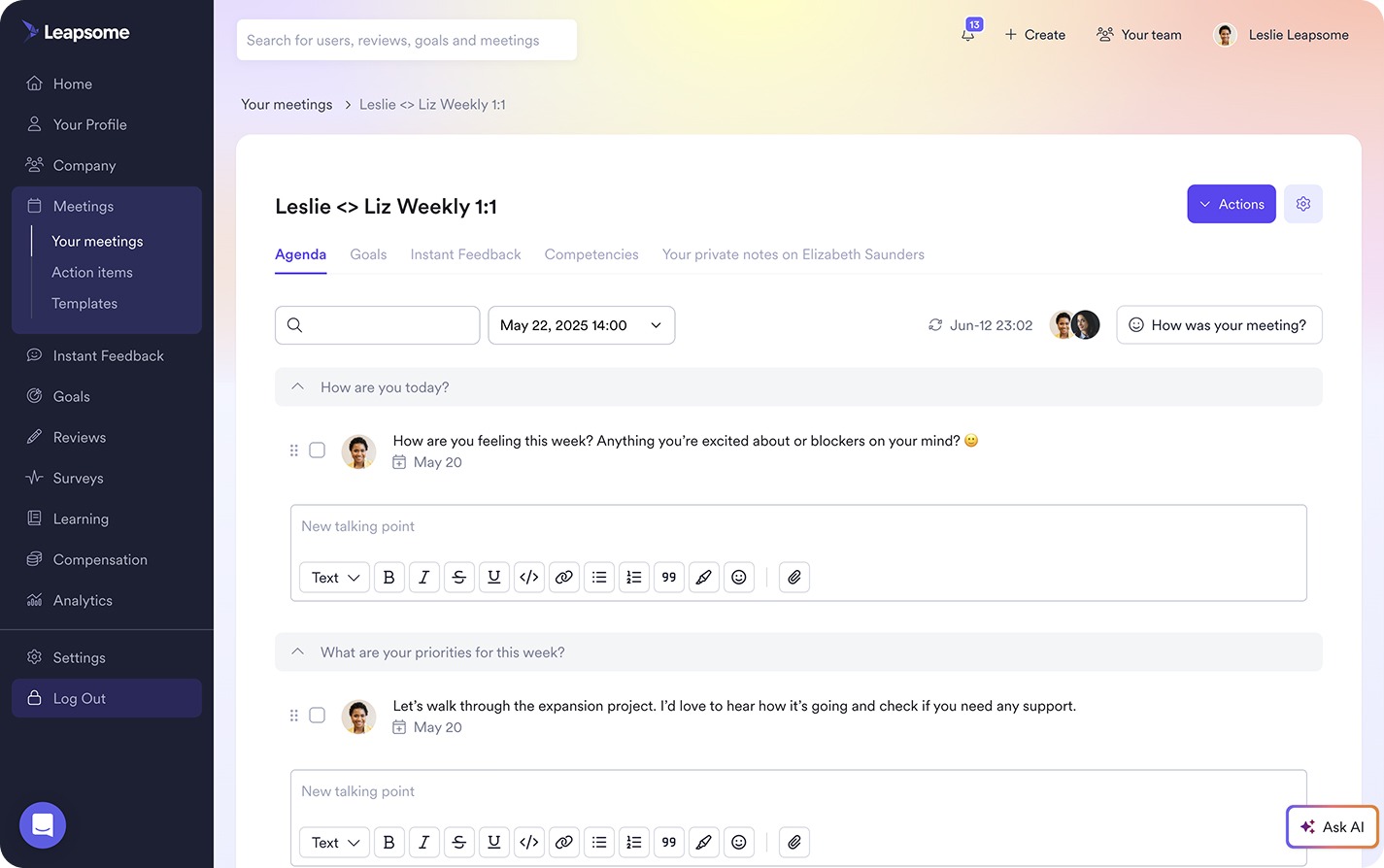
🤝 Get the most out of every meeting with Leapsome
Our Meetings module offers a structured, template-driven way to keep check-ins on track and make every conversation count.
👉 Learn more about Leapsome’s Meetings module
How to make 1:1 meetings a priority and a stable routine
The best way to get into a regular 1:1 meeting habit is to start early. For new employees, try to set up the first conversation and define a schedule within the first week. This sets the precedent that 1:1 meetings are important, not just a matter of form.
It’s also vital for everyone to be on the same page about when meetings will happen and what they’ll look like. For regular check-ins, a half-hour session once per week is a good baseline.
For 1:1s focused on specific areas, such as performance calibration, as-needed scheduling may be enough. But if the meeting’s topic is an ongoing situation, like monitoring a professional development plan, you may want to set regular sessions to gauge progress and keep the momentum going.
Either way, give the employee plenty of notice, and if possible, offer them a short agenda so they’re able to prepare. When both parties arrive with the same goal in mind, meetings are a lot more productive.
Plan meetings your talent looks forward to with Leapsome
1:1 meetings are powerful opportunities to gather actionable insights and nurture positive working relationships. They’re also tough to get right, especially if you’re still taking an ad-hoc, pen-and-paper approach.
With Leapsome’s Meetings tool, the groundwork for successful 1:1s is already taken care of. After you choose an expertly crafted template or create your own, you’ll have an easy-to-find roadmap that keeps every meeting running smooth. Just plug in notes during each session, and your meeting records will be securely stored and integrated with the rest of your HR data.
For a full HRIS toolkit, combine Meetings with other Leapsome features, like Goals to track employee progress, Instant Feedback to gain employee insights, and Learning to monitor professional development efforts.
🚀 Better 1:1s start here
Leapsome’s all-in HRIS helps managers run structured, impactful 1:1s thanks to expert-designed agenda templates, robust performance analytics, and centralized employee data.
👉 Request a demo
FAQ
What’s a one-on-one meeting template?
A one-on-one meeting template is a document that outlines key topics and questions to cover. By offering a clear, consistent structure, templates make it easier for managers to conduct meetings and capture critical information.
What agenda should I use for one-on-one meetings?
Naturally, we recommend checking out our one-on-one meeting templates for managers (we shared them above). You can choose from roadmaps for weekly check-ins, onboarding, and performance reviews, then adapt those frameworks for common situations and specific needs.
Marta Gomez-Taylor

.jpg)

.jpg)

.jpg)