Payroll calendar templates and best practices for management (weekly, biweekly, and more)

.jpg)
Running payroll accurately can be a long and dull process, one that eats up more than a quarter of the workweek for the average HR team.* And when you try to speed this process up, you can easily wind up scrambling to send out paychecks at the last minute. It may feel like you either lose time that could be spent on other tasks or risk errors. When it works, nobody notices. When it goes wrong, it can be a total disaster.
The fix is to step back, take a look at your payroll process, and then improve it from the ground up. We suggest starting with a payroll calendar, since this simple resource helps you visualize payment dates and plan ahead. Once the upfront work is out of the way (and we’ll help with that), you can start enjoying the benefits of following a payroll calendar: improved employee engagement, trust, and payroll reporting.
This article covers the most common pay schedules and looks at four payroll calendar templates. Consider them alongside your goals and current workflows, and pick an approach that keeps things on track paycheck after paycheck.
*Deloitte, 2020
How many payroll periods do you need to worry about?
Every payroll cycle has its own set of benefits and complications that will affect what your calendar looks like. Here are the most common periods and what they might mean for your payroll process:
- Weekly pay schedule (52 pay periods): The weekly pay period might be the simplest option, because it follows the traditional workweek. Employees naturally like getting paid this often, although it does put more work on your plate. Thursday and Friday are the most common paydays for this schedule, and it’s often used when hours and/or pay owed change a lot from week to week.
- Biweekly pay schedule (26 pay periods): The most common schedule is to cut paychecks every other week on a consistent day (that day varies, but it’s still usually at the end of the week). The biggest advantage is that you’re running payroll half as often, which takes less time and resources, but employees don’t have to wait too long to get paid.
- Bimonthly pay schedule (24 pay periods): Also referred to as a semi-monthly pay schedule, this approach distributes paychecks twice a month on specific calendar days (e.g., the 1st and the 15th). It’s a little simpler for accounting purposes, since you don’t have those awkward months with three pay periods, yet it’s still nice and consistent for employees.
- Monthly pay schedule (12 pay periods): Paying team members once a month is less common, because people aren’t crazy about waiting that long for their money. While a monthly schedule can make processing payroll simpler on your end, it also makes financial management trickier for team members. But it is a common choice for paying contractors and temporary workers.
Never miss a deadline again: Four free payroll calendar templates for 2026
Payroll mistakes cost companies an average of nearly $300, with serious errors reaching into the $700s or more. That’s bad for your bottom line and employee morale, but hard to avoid when you’re overworked and starting from scratch each pay period.
Following a clear payroll schedule template helps you meet your deadlines and offer fair compensation wait times. Pair one of these options with a timesheet template to streamline your payroll process from end to end.
Weekly payroll calendar template
Our template uses Fridays, one of the most popular days for weekly payroll schedules. In addition to marking out a time to send checks, know what day you’ll process payroll and stick to that religiously.
The margin for error is tight with this schedule, so we’d suggest doing the bulk of the work the day after each pay period ends. That gives you a couple of days to iron out any questions or missing timesheets.
📃 Get the full weekly payroll calendar template
If you’re running payroll every single week, your process has to be airtight.
👉 Download the template now
Biweekly payroll calendar template
Biweekly payroll looks almost the same as a weekly process, but you have a little more wiggle room in the schedule. Make sure there’s a nice buffer between when the pay period ends and when money is due.
Make sure to plan ahead for those occasional ‘three-paycheck’ months where you’ll have a bit more work to do. Let employees know how that deviation will affect their pay and benefits — for example, whether or not insurance premiums and other before-tax deductions apply to the third payment.
📃 Get the full biweekly payroll calendar template
Plan ahead for all the year’s payment dates, whatever months they fall into.
👉 Download the template now
Bimonthly payroll calendar template
Bimonthly schedules might be the simplest to manage. They’re very consistent, and the short intervals give you time to prepare payroll but don’t overwhelm you with too much data at once. All you really need to do is pick the two big days.
Most companies go with either the start and middle of the month or the middle and end of the month. For the former, you can simply opt for the 1st and the 15th. As for the latter, you may want to go with the 15th and the “last day of the month” rather than a specific day, or else February gets confusing.
Also, no matter what dates you pick, decide whether you’ll stick with them if they fall on weekends or shift payday to the following workday instead.
📃 Get the full bimonthly payroll calendar template
Bimonthly may be a straightforward schedule, but you still need a calendar to keep HR and employees on the same page.
👉 Download the template now
Monthly payroll calendar template
There’s not much complication to a monthly payroll schedule; you just pick the start, middle, or end of the month. You have a lot of options, so look at when HR is least busy with other tasks and get employee feedback on their preferences.
This schedule is the most common in the European Union, less so in the United States. It gives you the most work to do at once, and when you’re looking at a whole month’s worth of timesheets and benefits, you’re more likely to run into problems. Plus, when employees only get paid once a month, it can really hurt them if those checks are even a day late. So choose a payroll processing day that’s well in advance.
📃 Get the full monthly payroll calendar template
You can’t risk late payments on a monthly schedule, so have a clear, set-in-stone roadmap.
👉 Download the template now
Best practices for perfecting your payroll process
An efficient, well-defined payroll process gets team members compensated fairly and on time, and it helps your company stay compliant with employment legislation. Here are some tips for a seamless, headache-free payroll experience.
📋 Worried about overlooking something during payroll?
Check out our free payroll checklist so you’re prepared to process efficient, compliant payments.
👉 Grab your copy here
Let technology lighten the load
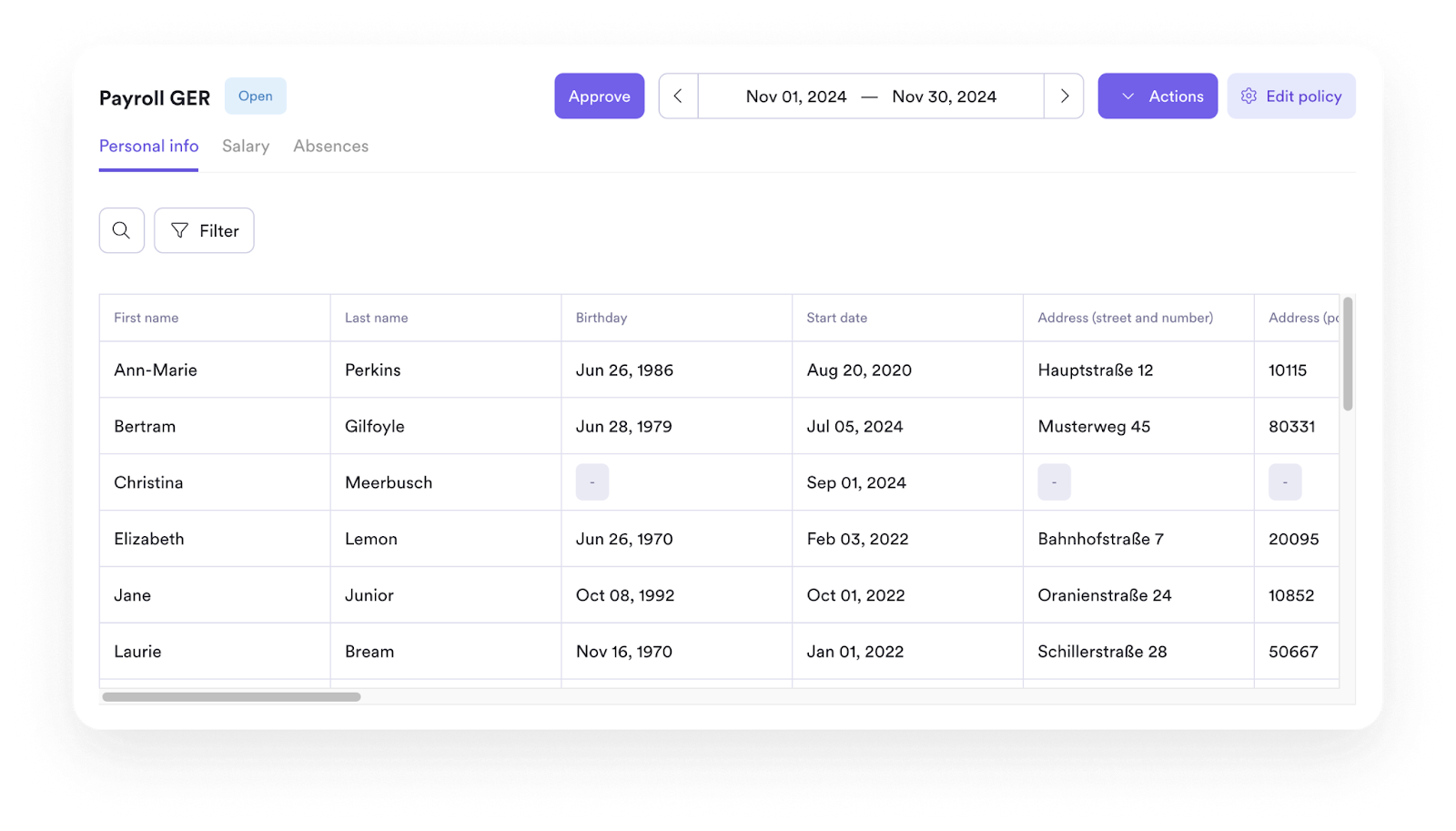
Using HR software with integrated payroll features makes routine tasks quicker and more effective, freeing your team to focus on the more strategic elements of your payment strategy (like compensation management). Look for integrated time tracking as well, so you can easily verify hours worked and observe trends.
Alternatively, consider implementing a full human resources information system (HRIS) with built-in payroll features. An HRIS like Leapsome brings all your employee data and payroll records under one roof for a more efficient process with fewer errors.
⏱️ Modernize your time tracking and payroll
Keep payroll centralized and up to date at all times, and automate the parts of the process that bog your team down.
👉 Learn more about Leapsome’s Payroll Preparation
Don’t neglect documentation and data accuracy
Clearly document your payroll workflows, including foundations like rates and schedules as well as big-picture work like auditing and tracking performance. This saves brainspace, since you don’t have to worry about what to do or missing steps — just lay out the path once and trust the process.
Then take some of the time you’ve saved and carefully verify data accuracy, looking at tax information, banking details, and role changes regularly. This reduces costs, because you run fewer off-cycle payrolls to correct mistakes. Also, these records are essential for financial planning, audits, and employee inquiries.
Be ready to pivot at a moment’s notice
Payroll and labor laws are always subject to change, so stay informed by reviewing regulations about minimum wage, payroll taxes, overtime pay, and so on. Set scheduled times to actively look for updates, and work with a specialized consultant if you can afford the help.
If you have a distributed workforce, you also need to keep an eye on what’s happening wherever your employees live and how that might affect your company.
Manage payroll effortlessly with a little help from Leapsome
A well-organized payroll process really has no downsides. It saves time, keeps you on track, gets employees paid on schedule, and protects the company from errors and violations. The only sticking point is that it takes some effort to set up a workflow that works great every period. But let the tips and templates above get you started, and you’ll be over the hump in no time.
Even the best laid plans can’t eliminate the complexity of payroll, especially for growing teams. That’s where Leapsome comes in — not as a payroll processor, but as the HR platform that connects to your existing payroll providers to keep everything in sync. With accurate data, automated updates, and all your HR workflows in one place, you spend less time reconciling systems and more time focused on your people.
🎰 Ready to streamline payroll (and everything else)?
Leapsome’s HRIS makes every pay period stress-free and turns your entire HR operation into a well-oiled machine.
👉 Book a demo
FAQ
What’s a biweekly paycheck schedule?
With a biweekly pay schedule, you’ll send out checks every second week on the same day, such as every other Friday. This differs from a bimonthly schedule, where you pay employees on the same two calendar dates each month.
Where can I find a payroll calendar template?
You can find four free payroll calendar templates above. They mark out pay periods for the most common schedules: weekly, biweekly, bimonthly (also called semi-monthly), and monthly.
Disclaimer: This article is for informational purposes only and doesn’t offer legal, tax, or financial advice. While we’ve done our best to ensure accuracy and completeness, we can’t guarantee everything is up-to-date or error-free. For tailored advice, we recommend consulting a qualified lawyer or tax advisor.
Leapsome Team





.png)