How to build effective employee training plan templates and programs


You’re benchmarking and planning development, progressions, and new hires in a talent market that’s simultaneously saturated and experiencing drought. Creating an employee training plan isn’t something you have time to do, but you know it’s one of the most critical projects on your plate.
Whether you’re trying to create a training plan from scratch, update one to be more compliant, or increase engagement, the process is never straightforward.
In this article, we share what makes training plans impactful and walk you through the steps needed to implement one within your organization. We even include an employee training plan template you can use to create your own, offering a comprehensive guide on how to make training plans that are both effective and engaging for your team.
Why are training plans for employees important?
An employee training plan is a written resource that details how your company will approach a specific training initiative.
For example, some individual contributors at your organization might be interested in becoming people managers. Your learning and development (L&D) team could support them by creating a leadership training plan that is results-driven, effective, and aligned with company goals.
Training plans for employees play a central role in advancing specific learning initiatives. They shouldn’t be confused with development plans, which are long-term guidelines for individual employees. In contrast, staff training plans are skill-based guides for groups or the entire company. These plans are valuable tools for addressing short-term skill gaps identified in personal development plans.
Key benefits of training plans include:
- Increased retention rates — 76% of respondents to SHRM’s 2022 Learning and Development Executive Summary said they were more likely to stay with a company that offered continuous training plans for employees. Organizational training plans are ideal for providing those opportunities as they streamline the employee development process and enable L&D teams to deliver more frequent, higher-quality training opportunities.
- Enhanced productivity and growth — Upskilling staff means they can achieve important goals and deliver the results required to keep the company operating at a high level. That’s one reason research shows that organizations that take training seriously are 59% more likely to grow.
- Better adaptability — As companies seek to meet the challenges of remote training and hybrid work, training plans can empower employees with skills to adapt to the ongoing changes in the world of work.
- More empowered employees — Learning and development should be a priority for any organization that cares about people enablement. Why? Because it pays off. According to our 2023 report, 89% of employees agree that people enablement has benefitted their workplace.
“In the past, we had a laissez-faire approach to training, allowing employees to select any kind they wanted. This sometimes resulted in misalignment between the training content and our company culture or Standard Operating Procedures (SOPs).
We’ve since adopted a more structured approach to remedy this, designing our training programs to align with our culture and objectives. This has ensured that every training employees receive is relevant and applicable to their role within our organization.”
— Jennifer Morehead, CEO of Flex HR, on the value a training plan has brought to the business
What types of training plan templates can you build?
It’s not enough to give managers a few talking points or a handful of notes; that’s how you end up with employees who have skill gaps or misunderstand expectations. If you want to scale employee development without sacrificing quality, you’ll need to create standardized templates that everyone can use.
Here are a few training plan sample ideas that cover basic skills and specialized training:
- Onboarding templates — These reusable guides streamline the transition for new hires, by outlining essential company knowledge and role-specific tasks. This way, everyone who joins the company receives a consistent introduction to your culture and their core responsibilities from day one.
- Skills development templates — Managers can use these templates to target skill gaps they identified during performance reviews. Skill development usually focuses on measurable growth, like using new software or improving public speaking skills.
- Compliance training templates — These frameworks ensure that all employees meet industry regulations and internal safety standards. Thorough compliance training protects both your organization and employees.
- AI literacy and augmentation templates — Use these to help your team get used to new technologies and learn how to use them efficiently. Top-tier organizations like JPMorgan Chase and Procter & Gamble invest in AI upskilling to help their teams scale more effectively.
- Power skills templates — These training plans focus on the human side of work, including conflict resolution and strategic thinking. According to a study conducted by EQ researcher Daniel Goleman, EQ skills account for 85% of leadership success and build a foundation for career durability.
- Resilience and holistic well-being templates — With this type of training, employees learn to overcome high-pressure workflows and focus on sustainable productivity. For example, holistic training programs for employees might show them how to identify stressors early, rather than just powering through challenging situations and burning out.
Benefits of using employee training templates
Instead of starting from scratch each time you need to work with an employee, build a reliable base of training program templates that allow managers to focus on actual coaching and employee engagement, not rote admin work.
Employee training templates:
- Save time — You can skip the repetitive heavy lifting, since you don’t have to build a new framework for every training initiative. Templates let you launch existing programs faster, and respond to new needs by leaning on a structure that already works.
- Improve organization — A template serves as the definitive go-to solution for development initiatives across your organization. You’ll stop losing progress due to disjointed records, and start building a searchable history of team growth.
- Create consistency — Standardized templates offer every person the same (high bar) of support, regardless of their department or manager. This lets you build a learning structure that stays reliable even as your organization scales.
- Promote accountability — Templates transform a vague desire for development into a specific set of milestones with clear deadlines. With that level of transparency, you communicate to employees and managers alike that professional growth is a non-negotiable priority.
- Drive retention — Employees tend to thrive on clear structure, since they know exactly what’s expected of them and why. For instance, a consistent and robust onboarding process makes employees 58% more likely to stick around for three or more years.
How to create an employee training program in 6 steps

Now let’s get into how to create an employee training program that’s scalable yet customized and aligned with company goals.
1. Identify knowledge and skills gaps

Skills gaps within your organization likely have more to do with technological advancements and market fluctuations than employee competence. Therefore, it’s crucial to consider short- and long-term business goals when assessing skills gaps and writing a training plan.
Let’s say one of your objectives is to make artificial intelligence (AI) central to your operations. You may find that team members are still unsure how to apply these new tools to increase the business’s operational efficiency.
To discover where upskilling and learning opportunities are:
- Survey employees — A short, two-question pulse survey asking staff what skills they need to execute their roles can provide useful insights.
- Re-examine your competency frameworks — If you’ve updated your company structure, employees may need new skills or competencies to flourish.
- Study your industry and competitors — Leverage your network or reach out to peers to learn what skills and knowledge gaps they’re facing and prioritizing.
🛩️ Looking for a great template?
You don’t have to create your employee training plan from scratch. Use our template to get started faster.
👉 Download now
2. Determine training objectives
Now that you have a better grasp of the skills employees are missing or need to expand on, you can begin to outline a set of objectives that will guide each plan. While your training plan objectives should align with your company vision, keeping them more attainable and specific than any high-level, long-term business goal is best.
Let’s look at some common training objectives:
- Enhancing a technical skill or competency with software
- Developing intercultural competencies that support diversity, equity, inclusion, and belonging (DEIB)
- Expanding industry and regulatory knowledge
- Improving customer service skills
- Sharpening decision-making skills
- Becoming more confident with conflict resolution techniques
- Managing time more effectively
🔎 When considering a set of training objectives, stakeholders should ask themselves these questions:
- What’s the desired outcome of this training?
- How will the new skills or knowledge contribute to our business goals?
- How will trainees benefit from the new skills or knowledge?
- What do employees need to do to succeed with this training plan?
- How will trainers or leaders know when employees have successfully completed the training?
- How will trainers overcome challenges to the training, if any?
3. Choose the type of training
Each training plan should invite you to consider the most appropriate methods and resources to meet skills gaps, stay within budget, and accommodate team members’ needs. Consider, for instance, that DEIB skills training for managers may require sensitivity and involvement from expert speakers, as well as a focus on topics like intersectionality, unconscious bias, microaggressions, and power dynamics.
This is markedly different from, for example, a simple training session on how to use a new type of software. Similarly, think about how distinct training remote employees can be from training an in-office team. Requirements relating to different skill sets should be taken into consideration when planning this out.
Let’s explore a few different training plans and discuss the specific competencies each might address.
New hire training plans
Typically part of the orientation and onboarding process, new hire training plans focus on familiarizing new employees with job expectations, policies, and procedures. The objective is to integrate recent joiners into their new team so they can become comfortable and reach their full potential quickly and sustainably.
The employee onboarding experience is the first real impression a new team member gets of your company and can set the tone for the rest of your relationship with them. Gallup found that low engagement has cost US$8.9 trillion (9% of global GDP), and only 23% of employees worldwide feel engaged.
While this number is too large to make sense of in the context of creating a training plan, the point is that employee engagement (and long-term company success) starts with an intentionally designed onboarding course.
⭐️ Create a seamless onboarding experience
Follow a thorough onboarding checklist that reduces new hire overwhelm and sets team members up for success.
👉 Download our comprehensive checklist
Customer service training plans
Sales and customer relationship management are challenging skills to build. This type of training should provide resources and techniques that employees can review to retain customers and bring in more revenue; some training examples are relationship building and consultative selling.
Technical training plans
This type of training isn’t only for companies specializing in IT and software. Organizations that rely on powerful tools to run their businesses must provide specialized resources (and ample time for employees to learn how to leverage them) to maximize their investment.
4. Establish how to measure effectiveness
Evaluating the success of your training plan helps gauge whether the training is meeting your established objectives and helping you progress on broader company goals.
Great training should positively impact multiple areas — like performance, productivity, engagement, and retention. That’s why you should utilize various approaches to measure effectiveness, such as:
- Completion rates — Quickly determine whether training is too difficult or too long and investigate what might be hindering people’s progress.
- Survey scores — Gather post-training employee feedback via anonymous surveys to determine if the plan is enhancing skill sets and allowing team members to perform their current roles more effectively.
- Percentage of goals reached — Observing how many employees are reaching their individual training goals means you can understand how quickly people are progressing through the program. Leapsome’s flexible Goals module allows you to set both OKRs and SMART goals and track results in real time.
- Qualitative feedback — Leaders can set up 1:1 meetings with training participants to discuss how things are going and explore what could be improved.
5. Set your timeline
Depending on what you need your training plan to achieve, you may choose a stricter or more flexible, self-paced timeline. For instance, mandatory short-term technical training might require a hard deadline, while employees could be able to complete voluntary time management training at leisure.
The key is giving team members a visual tool to track their progress throughout the course — which is why you should break your timeline down with the following:
- A training schedule — For courses happening in multiple sessions over several months, provide employees with a weekly or monthly schedule so they can plan their time accordingly.
- Checklists — For self-paced courses, allow staff to mark tasks off a list of projects and activities.
- Milestones — Managers can inform participants when they’ve reached specific achievements or met certain targets.
6. Create & choose training materials

Building training materials internally helps make training more relevant and specific to your business goals. It also enables you to keep your messaging consistent with your company values and tailor teaching resources as you go. However, there are a few benefits to sourcing training externally, as it can:
- Provide external perspectives to diversify insights, broaden thinking, and introduce new approaches to problem-solving
- Allow access to professionals with specific expertise or specialized certifications
- Support employees in connecting with industry experts and help build their professional networks
- Be less time-intensive
While they require an initial time investment, in-house materials can be just as effective and may include:
- Webinars or online presentations
- Training videos
- Games and bite-sized courses
- Online forums or internal communities
- Interactive elearning modules
Employee training plan template
.jpeg)
Employee training plans should be easy for leaders, managers, and team members to understand, follow, and implement. Here’s a sample template you can fill in — simply tweak the details and structure based on your branding, messaging, and needs.
Course overview
This is where you’ll write the following:
- Name of your organization
- Course name
- Department, team, position, or specific employee the course is for
- How long it’ll last (especially if the course isn’t self-paced)
- When the course was last updated
Training objectives
Clearly state your learning goals for the course. What short- or long-term objectives do you want the training to achieve? For example, if you’re building a management training plan, your goals may include:
- Helping managers develop their confidence as coaches and mentors
- Sharpening decision-making and problem-solving skills
- Identifying strengths and areas direct reports can improve upon
- Enhancing team collaboration and effectiveness
Delivery methods
Explain whether the training will take place in-person or online and give a brief overview of its structure. While the learning process may be completely asynchronous for new hires, trainees might be expected to spend two hours a day working through tasks, activities, and quizzes over a week.
Training content, schedule, or modules
Here, you’ll break the training into smaller components to help employees digest the information and stay organized and on task. If team members need to complete a set of learning modules and activities to finish their training, you can provide a checklist here.
You can either design your own content or work with content marketplaces. Platforms like Leapsome Learning have a variety of modules: like compliance training, leadership training, and other content for specific training programs.
Monitoring & follow-up
Explain what metrics and tools participants and organizers will use to measure their progress and success throughout the training.
As an example, L&D teams may ask trainees to track progress throughout the course by monitoring module completion rates, reviewing scores on quizzes and tests, and updating individual training goals. Then, after the training is completed, leaders may follow up in regularly scheduled 1:1s and discuss how the employee is implementing the training in their day-to-day role.
Making the best use of your employee training templates
A training plan does no good if it’s ignored or followed in an ad-hoc way.
Here’s how to make sure your training templates drive behavioral change and measurable team performance:
- Personalize with intention — While templates are great for common training needs, they’re not a one-size-fits-all solution. Many templates should be tailored to the individual’s career path, department, experience, and so on.
- Design for active involvement — Interactive learning can boost knowledge retention, so move beyond passive lectures and throw in tools that require reflection and participation. For example, you could include a scenario-based response section where the employee needs to explain how they would handle a project roadblock. Or you might incorporate a habit tracker, where the employee commits to working on a behavior or skill over time.
- Address diverse learning preferences — Make sure your materials are accessible to all employees, by considering those who use screen readers or have vision impairments. It’s also smart to mix up different delivery methods, like webinars and e-learning modules, to keep engagement high for all learning styles.
- Leverage social learning — According to the protege effect, knowledge sticks better when it’s shared. Use your templates to prompt collaborative moments, like “teach-back” sessions where an employee explains a new concept to their team or a peer. This turns a training session from a solitary task into a collective learning opportunity that strengthens team bonds.
- Prioritize micro-learning moments — Avoid overloading your employees by breaking complex training sessions into bite-sized, manageable actions. Instead of a day-long seminar, for instance, try structuring your templates around 15-minute sprints that focus on one skill or takeaway each.
- Incorporate adaptability — As the business shifts, so should your templates. Treat training materials as living documents, and update them frequently to reflect changes in technology, business goals, or team structure.
What to avoid when planning employee training
Implementing a new training plan takes trial and error and may not always produce the results you hope to see right away. However, taking note of typical training plan pitfalls ahead of time can help eliminate the need for extensive refinement down the road. Some possible issues include:
- Setting unrealistic expectations — Making your plan too ambitious could discourage employees who feel it’s out of touch and impossible to complete. When in doubt, keep timelines relatively short and make objectives as specific and achievable as possible.
- Providing team members with insufficient time — Even if training isn’t mandatory, not giving people enough free time to take advantage of learning opportunities might convey that their success isn’t your priority. Allow employees to carve out time away from tasks to complete training, and encourage them to create recurring calendar blockers to focus on their personal development.
- Not explaining “the why” — If you’ve created training plans in response to specific organizational challenges or skills gaps, let team members know. Otherwise, failure to be transparent about your reason for implementing training might lead people to draw unfavorable conclusions or lack motivation.
- Not asking for feedback — Employee input is a powerful way to evaluate the effectiveness of your training plans. Without those insights, you risk investing in training that doesn‘t align with your team’s needs or preferred ways of learning.
- Implementing a plan that doesn’t align with individual goals— Not considering people’s personal development goals might prevent trainees from feeling a sense of empowerment and ownership over their new skills, which can harm motivation and engagement, even beyond the training phase
Train and develop your people with Leapsome
By providing a structured, strategic approach to learning, a well-crafted training plan can help upskill staff members more efficiently while addressing the knowledge gaps that might be holding your company back.
Still, it takes time and collaboration to gather the data, resources, and materials you need to develop and implement a successful training plan. What’s more, you may find that your current people enablement tech stack overcomplicates the process.
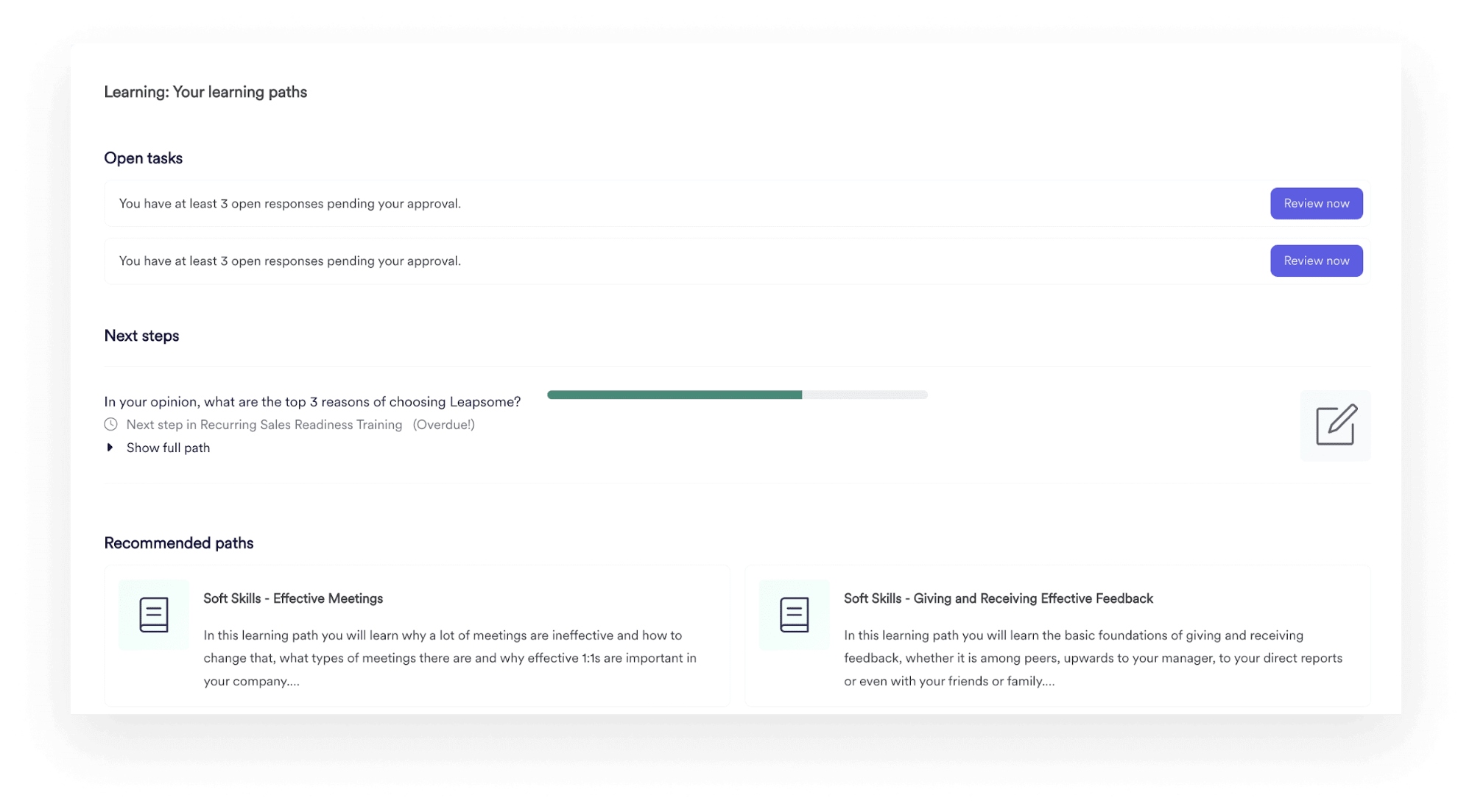
Leapsome is the perfect platform for organizations that want to simplify planning and offer training at scale. Users can use our Surveys and Meetings modules to collect employee feedback, our Goals module to track learning objectives against company targets, and our Learning module to deliver interactive courses. Plus, configurable analytics dashboards allow you to monitor completion and success in real time — so you can tweak your training plans on the fly.
👊 A platform that helps you roll with the punches
Leapsome Learning integrates with surveys, goal-tracking, and powerful analytics, so you can implement training efficiently and adapt it as you go.
👉 Book a demo
FAQs about employee training plans
How do I create a training plan for employees?
To build an employee training plan, start by identifying the gaps between current performance and expectations or development goals. Once you find a gap, set a specific, measurable goal that aligns with the broader company vision. Then choose a training format, like a workshop or a self-paced module, and set a timeline to make sure the training stays a priority.
What’s a training planner, and how do I use one?
A training planner can be a template for a training schedule, or it might be a digital tool that maps out the entire development journey for a team or individual. Either way, the planner functions as a centralized place where you can find resources, schedule sessions, and track how training hours translate into measurable ROI.
Leapsome Team



.jpg)
.jpg)