How to reduce employee turnover: Three ways to intervene earlier


No one wants to find out their organization has a high employee turnover rate. Climbing numbers usually trigger a few urgent meetings, a generic retention push, or maybe a new exit interview template. But in the rush to lower that rate, leadership often doesn’t take a closer look behind the numbers.
Turnover is expensive, and backfilling empty roles means spending more money on talent acquisition while operational capacity dips. Yet there are plenty of ways HR can prevent rising turnover rates; Gallup found that 42% of employees who voluntarily left their organization said their manager or company could have done something to prevent their departure.*
Instead of unrealistically trying to keep every employee forever, HR leaders should focus on understanding when people start to feel unsupported or overlooked before resignation becomes their only choice. When signals that point to weak manager relationships and stalled development live in disconnected systems, warning signs brew in the background while unresolved issues push top talent out. Having enough visibility into these insights means HR teams can take action sooner and use this information to shape the workplace into an environment where everyone can grow and succeed.
This guide explores what causes employees to leave, which early signals matter, and how to reduce employee turnover with strategies that not only help people stay but also perform at their best.
* Gallup, 2024
What’s causing employee turnover?
Before rushing into retention fixes, it’s important to understand a few common causes of turnover:
- Limited career development: Employees leave when they feel stagnant and can’t see how the role connects to their broader career goals.
- Low engagement and recognition: Team members disengage when strong work goes unnoticed and feedback feels vague at best.
- Compensation and workload concerns: According to Gallup, pay is one of the most important factors employees consider when deciding whether to stay. Workload ranks high on that list as well, and can sway the decision when hefty workloads contribute to burnout.
Turnover is a lagging indicator, not the problem
High turnover numbers create a state of urgency that blurs the bigger picture for most HR teams. Rather than treating turnover as a problematic workforce number, it needs to be viewed as a symptom of employee experience problems that started months ago — when there was still time to act.
Exit interviews can explain why someone left, and they’re a valuable tool for pattern-spotting, but they can’t help you repair relationships. That makes them less reliable for preventing the resignation in front of you, and changes based on exit interview feedback won’t necessarily stop employees on the fence from deciding it’s time to leave.
A strong retention strategy watches leading indicators for turnover, but those early retention risks rarely come with flashing lights. More often, they show up as small changes in how employees participate and plan their future at the company.
Employees who are considering leaving might display some of the following warning signs:
- They stop investing in what comes next: An employee skips development sessions, stops updating goals, or shows less interest in internal opportunities than before.
- Their work becomes more transactional: A usually proactive employee keeps doing what’s required, but brings less curiosity and ownership to their tasks.
- Their motivation drops before performance does: Output may still look normal, but participation in feedback and team discussions starts to fade.
How to reduce employee turnover: Three strategies
Here are three ways to reduce employee turnover and improve your employees’ experience before high performers start taking recruiter calls.
1. Invest in manager effectiveness
"An ineffective manager doesn’t take time to understand their people or build trust. The best ones care deeply, they know where you want to grow, challenge you when needed, and make space for honest feedback."
— Luck Dookchitra, former VP of People and Culture at Leapsome
Managers influence the workforce so much that they should be the starting point of your retention strategy. Employees rarely experience “the company” in the abstract, but rather through their manager’s support, feedback, and follow-through. In fact, Gallup has found that managers account for at least 70% of the variance in employee engagement scores, and 21% of employees listed better interactions with managers as a reason to stay.
Strong managers create regular space for honest conversations about work, not just status updates. They notice when someone is more quiet than usual in one-on-one meetings or is struggling with work-life balance. Those moments are easy to miss when managers are stretched, but are where preventable turnover signals start to appear.
“Managers can’t fix everything, but they can create calm. It’s about showing care, being transparent, and helping people focus on what they can control.”
— Anja Schauer, Global Head of Customer Success at Leapsome
To reduce turnover and absenteeism, HR managers need a system that connects people processes through the entire employee lifecycle. This way, managers can give constructive feedback to their direct reports and spot growth opportunities before employees start looking for that support at other organizations.
2. Create clear career growth and development opportunities
"Employees who keep learning will outrun automation. The organizations that invest in skill growth will retain that talent and thrive."
— Jonathan Passmore, SVP at Ezra (Adecco Group) and Professor of Coaching and Behavioral Change at Henley Business School
Most companies know growth matters for retention. According to LinkedIn’s 2025 Workplace Report, 88% of organizations are concerned about employee retention, and providing learning opportunities is their number one retention strategy. But when teams rely on different tools for goals, performance feedback, and career conversations, HR teams are more likely to miss the moment when an employee starts to feel their growth is limited. By the time HR spots the pattern, that employee may already be on the market.
To reduce employee turnover caused by a lack of development opportunities, organizations need to make career growth visible and actionable. Offering internal training and, in some cases, third-party development programs is one way to open the field. More importantly, employees should understand what skills they need to build, managers should know how to support the next step, and HR should be able to see where development is stalling and push it forward.
3. Listen to employees and act on feedback
"When people know reviews actually lead to growth, they stop dreading them and start investing in them. Linking feedback to concrete outcomes like pay, promotions, and learning plans turns performance conversations into moments of empowerment."
— Monica Sarkar, Co-Founder of Purple Umbrella
What looks like a communication gap is often a retention risk. Gallup found that almost half of voluntary leavers had no proactive conversations with their manager or a team leader about their job satisfaction or performance in the three months before they left.
Instead of relying on exit interviews for a few honest words at the end of the working relationship, organizations need consistent two-way communication where employees feel comfortable sharing what’s working or not, and managers show the employees that the feedback makes meaningful changes. Engagement surveys, pulse checks, and regular one-on-ones can help, but only when HR has a way to connect the dots and act.
Strategic teams rely on HRIS and talent management systems like Leapsome to move from occasionally listening to 24/7 visibility. When you can run an engagement survey and collect and analyze the data in one place, it’s easier to spot sentiment trends and create action plans before unresolved issues turn into resignation.
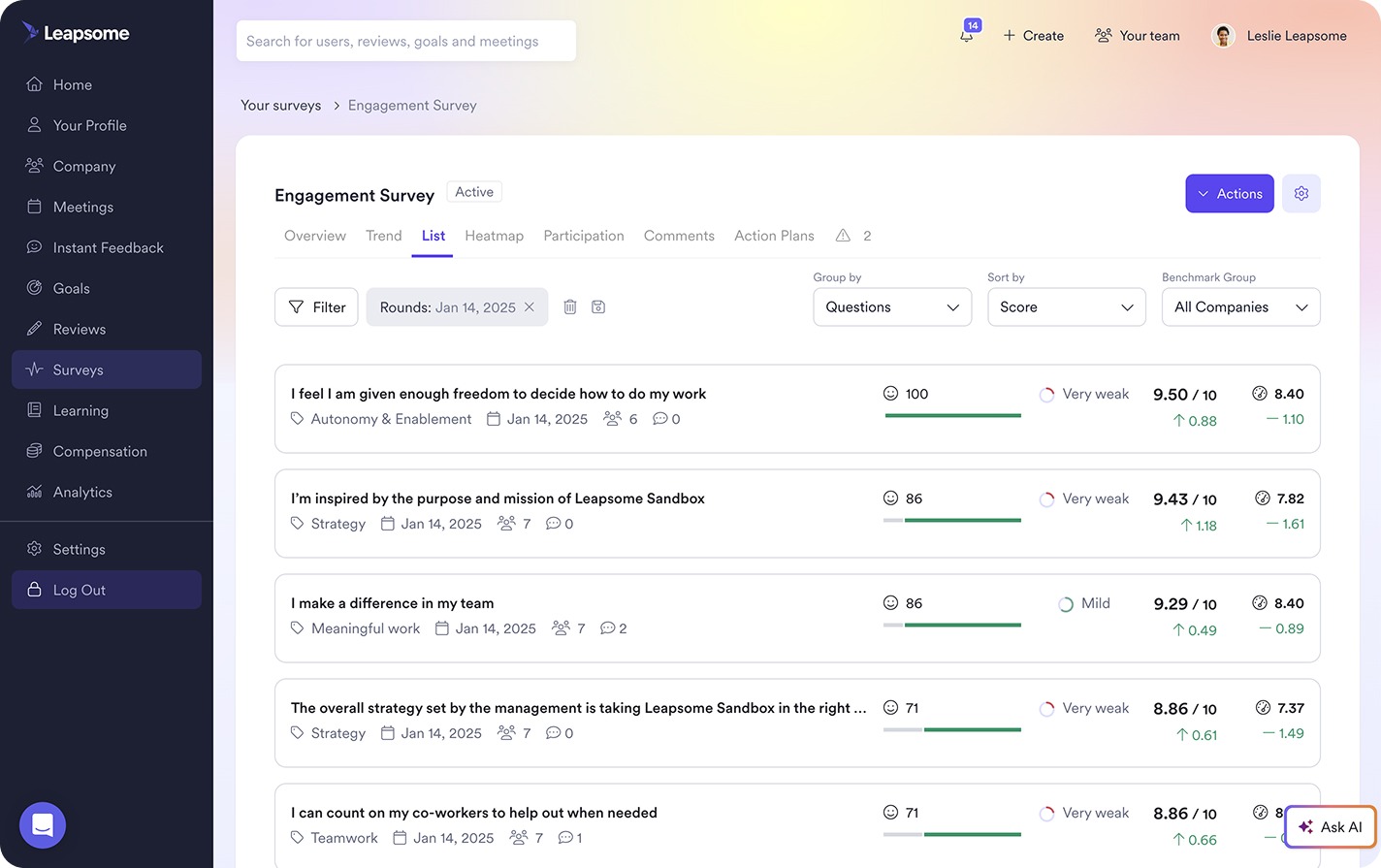
🦗 Act on retention signals before you hear crickets
Leapsome’s Engagement Surveys feature helps HR teams gather feedback at scale, uncover sentiment trends with AI-powered insights, and address concerns before employees disengage.
👉 Explore Engagement Surveys
The best retention strategy is better visibility
Retention doesn’t improve because HR launches more programs after people leave. It improves when the organization can see risk early enough to respond and improve the workplace for employees on the fence.
That risk visibility exists across the employee lifecycle. Manager feedback, engagement trends, and performance patterns work together to tell an employee’s story. When those signals sit in separate tools, turnover becomes a surprise. A connected system means HR can spot where the employee experience is starting to break, with plenty of time to build a program that’ll actually help the core issue.
High retention isn’t always a sign of a healthy organization
Low turnover can look good in a leadership report, but it doesn’t always mean people are thriving. Sometimes it means internal mobility is weak, or managers just aren’t addressing poor performance. The goal of a strong retention effort isn’t to keep everyone forever — it’s to keep the right people for the right reasons and support them while they’re here.
Look beyond the company-wide turnover rate
A company might have a stable overall turnover rate while one manager keeps losing high performers or one critical role group quietly houses all the flight risk.
To get more granular results, HR teams should break turnover down by:
- Manager
- Department
- Tenure
- Performance level
- Critical skill group
In a platform like Leapsome, HR can connect those individual turnover numbers with survey responses and leading indicators like engagement and development progress. This holistic picture helps teams zero in on retention efforts where they will have the most impact.
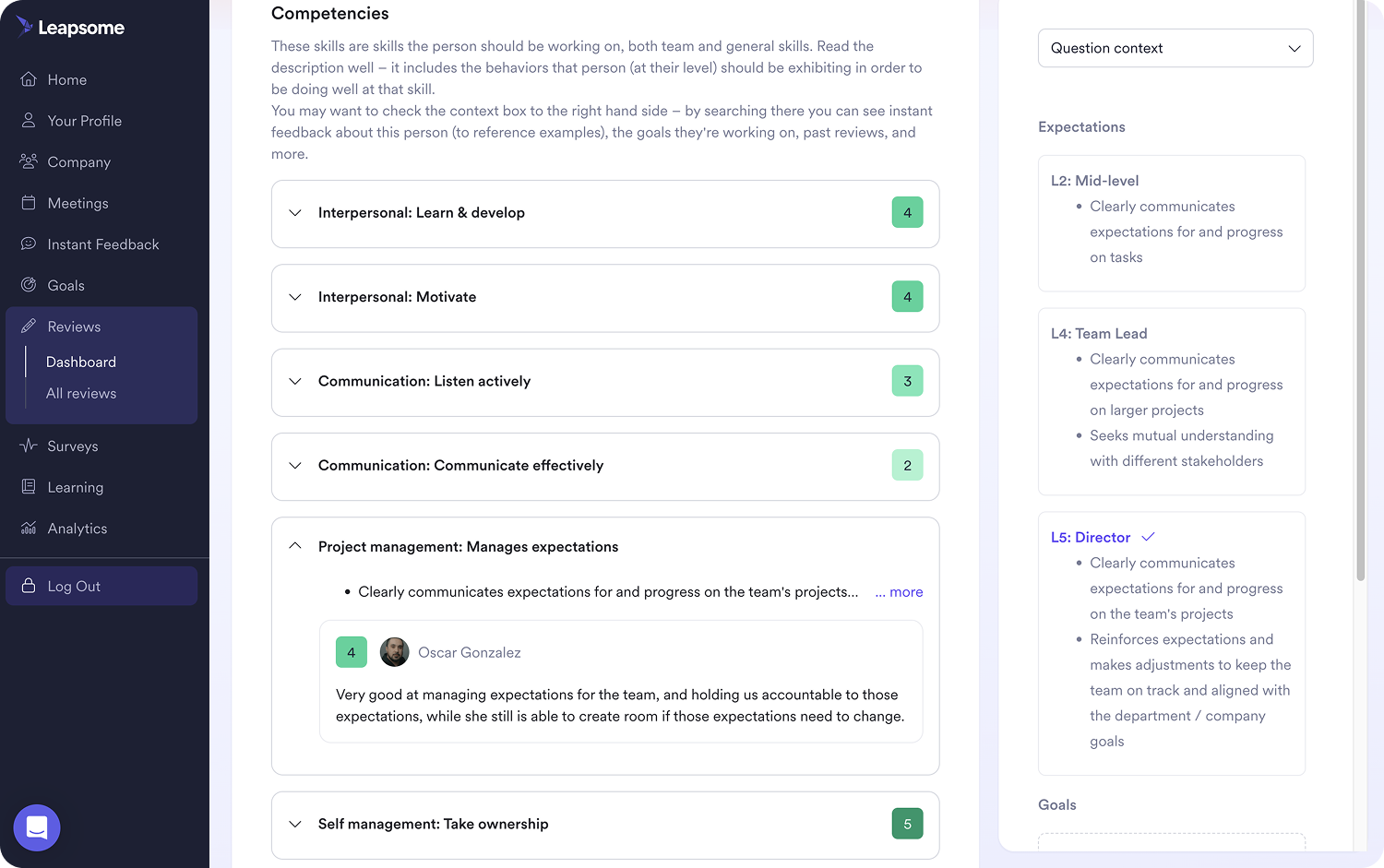
🕵️ Identify retention risks through people insights
Leapsome’s Performance Reviews feature helps HR teams collect and analyze performance and development insights, so every retention effort can make the biggest difference possible.
👉 Explore Performance Reviews
How Leapsome helps organizations reduce employee turnover
Most resignation letters symbolize the final step of a decision that has been building for months. Frustrations from unclear growth paths, little recognition, and feedback that never turns into action all add up until they push out even the most resilient high achievers.
HR teams can pick up on leading indicators ahead of those voluntary resignations, but fragmented systems make it harder to connect them to turnover risk. Leapsome brings those signals together in one AI-powered HRIS platform, helping HR teams use:
- Engagement surveys to measure sentiment, uncover team-level trends, and spot where employees may need a morale boost.
- Performance reviews to connect performance patterns with manager support and development needs.
- Learning and competencies to understand whether employees have clear growth paths and the skills to support development.
- Goals and OKRs to connect individual work to team priorities, clarify what progress looks like, and show when employees might be losing direction or momentum.
- 1:1s and feedback to turn manager conversations into clearer insight on employee needs, blockers, and retention risk.
"With Leapsome, we’ve seen some amazing improvements. The initiatives we identified from the survey results decreased our turnover by 12.2%, increased our survey participation rate to 82%, and it made people more productive and excited to come to the office. Listening and transparency is a part of our culture now." — Natasa Kovacevic, People and Culture Manager at Eurowings Digital
🤝 Retain, don’t replace
Leapsome connects engagement, performance, and development insights, so HR teams can spot retention risks early and reduce employee turnover.
👉 Request a demo



%20(1).png)

.jpg)