How to write a self-evaluation: 57 ways to improve performance reviews


Performance reviews have a bad reputation. Blame it on decades of toxic workplace cultures in which fear was used as a driving force — and an extremely inefficient one. Unfortunately, this outdated notion of performance reviews still lingers, which can make you fear a process that, as forward-thinking companies now understand, can boost engagement and development, foster collaboration, and promote the growth of organizations.
It's time we use performance reviews to drive self-development, not fear!
Enter self-assessments, a critical part of performance reviews. According to coach and people enthusiast Sophie Schönicke, self-evaluation “helps the participant compare their self-perception with external views and recognize strengths and areas for development.” Yet, instead of a productive conversation that can benefit your career and personal development, what you may be picturing is an image of yourself on a therapist’s couch — and with an audience.
Granted, not every employer is as progressive as they could be, and performance reviews are still misused by many. Still, you should think of your self-assessment as something you’re doing for your benefit. It’s an opportunity to focus on your growth, have your achievements recognized, and discover your strengths. What’s more, expressing your thoughts and knowing how you’re perceived will potentially increase transparency at work.
In this guide, we’ll explore how to write a self-evaluation that deepens your performance reviews, with all the information (and inspiring examples) necessary to get started.
What’s a self-performance review?
A self-performance review, also called self-evaluation or self-assessment, is a structured process where employees reflect on their progress and performance over a specific period. Most companies run these as part of a broader performance review cycle every quarter, twice a year, or annually.
Since self-evaluations tend to come after months of work, it can be hard to remember all the details. Notes about important goals and accomplishments may be scattered throughout documents, messages, and spreadsheets — or put into memory and promptly forgotten. This lack of documentation creates a weak review process. Employees either undersell their impact because they forgot about their wins, or they rely on vague statements that don’t give managers enough evidence to reinforce their claims.
A strong self-performance review should be more than a simple summarization of tasks you’ve worked on. It’s an opportunity to explain what you’ve achieved, what challenges you’ve had to overcome, and what support you might need for future action plans. This approach also gives managers a more detailed perspective before they add their own employee feedback.
Effective self-evaluations are easier when there’s a clear process for tracking performance throughout the year. When you can reference feedback from past reviews, project outcomes, and development notes in one place, self-assessment becomes more accurate and useful.
Prepping for effective employee self-assessments
Before you start writing a performance review (with examples) for yourself, take some time to gather information. Make sure you’re always reflective and grounded, and provide enough detail that your manager can connect your work with company OKRs and business priorities.
Here are a few tips that can set you up for a strong self-evaluation:
- Gather performance data before you start: Instead of relying on your memory, go through your completed tasks, performance metrics (if you have access), and any instant feedback from your manager or peers you received during the review period. This way, you can back up self-assessment examples with precise data.
- Connect your work with company goals: Once you have concrete figures and notes in front of you, use them to show how your work supported the organization’s bigger goals. This is especially important for managers and employees in people roles, like HR operations or customer success. In these roles, it can be easy to miss your contributions because strategic, proactive people work often prevents visible problems. If you improved an onboarding workflow or resolved a customer issue before it escalated, for example, connect those tasks to team impact or business goals.
- Use challenges to show growth: Your self-evaluation should include how you handled setbacks, not just highlight your wins. The key is to explain what happened, what you learned, and what changed afterward. For example, if a project was delayed because responsibilities were unclear, you could explain how you’ve implemented a new personal checklist to confirm task owners and timelines earlier in the process.
- Look for patterns across feedback: You might brush off one comment, but repeated feedback usually deserves more attention. If peers consistently praise your reliability, include that as a strength. If several people mention that your updates come too late, treat it as a development priority. A centralized performance system makes these patterns easier to see because it captures feedback as work happens and doesn’t disappear after the conversation is over.
Benefits of a good self-evaluation
Self-evaluation gives employees the opportunity to assess their skills and areas of development. It's an important aspect of any 360 review because it gives employees time for introspection and analysis of strengths and weaknesses. Self-evaluations offer several benefits including:
- Personal growth: Self-evaluations allow employees to reflect on areas for improvement and growth. Individuals are encouraged to identify past challenges and set development goals to progress professionally.
- Self-awareness: Self-evaluation fosters self-awareness through self-reflection on past mistakes, wins, and challenges.
- Increased motivation: Employees who regularly assess their performance will notice improvements and feel a sense of accomplishment which in turn motivates people to strive for continued success.
- Improved performance: By evaluating their own performance, employees gain a deep understanding of areas for improvement and can work on actionable strategies to improve their performance.
- Accountability: Self-evaluation gives employees a sense of responsibility for their own actions. Employees who write self-assessments become more proactive in their actions and decisions in order to meet their own standards.
- Decision-making: Regular self-evaluations help employees recognize patterns and learn from mistakes, leading to better decision-making in the future.
“[Leapsome] acts truly like an assistant — like a coach. It helps you brainstorm, reflect, and draft reviews in a personalized manner.” — Aubrey Bryan, Senior Customer Success Associate at Leapsome
👀 Are you dreading your next performance review?
Reviews don’t have to be unenjoyable. We’ve made Leapsome to deliver development-oriented and actionable performance reviews to everyone.
👉 Learn more
57 self-evaluation examples
Getting the phrasing right in performance reviews can be tricky for some people. That's why we've created this list of self-evaluation examples based on different categories. Save them for your next performance review to feel more confident in giving feedback.
Problem-solving and management
The ability to analyze problems and come up with creative solutions is crucial in a business context so it’s important to assess whether employees are doing this in an effective manner.
Positive
- I am very capable of breaking down complex problems into manageable initiatives.
- I consistently think outside the box and am able to generate creative and novel approaches.
- I consistently make well-thought-out and timely decisions.
- I have a track record of achieving tangible results and meeting objectives.
- I have been able to successfully manage initiatives and achieve the targeted results.
Constructive
- I struggle focusing on the root causes of problems and so often apply temporary solutions or "quick fixes."
- I become overwhelmed when circumstances change and I need a lot of time to adapt my strategy to accommodate new challenges.
- I am afraid of taking ownership and tend to delegate responsibility when possible.
- I have been told that I am over-engineering solutions and have a hard time communicating my ideas clearly.
- I have a hard-time sticking to agreed upon timelines for initiatives and often have to push back on deadlines.
Communication
“Good feedback should be in the moment, evidence-based, and catch people doing it right.”
— Jonathan Passmore, SVP at Ezra and Professor of Coaching and Behavioral Change
Clear and effective communication is an important skill in any team. It's important for employees to regularly assess their communication with colleagues and managers.
Positive
- I actively listen to my colleagues and give thoughtful responses.
- I am able to convey my ideas in a clear and concise manner.
- I am open to feedback and react in an appropriate manner even when faced with constructive feedback.
- I actively seek input from my colleagues and value their opinion.
- I have shown the ability to mediate conflict and work out solutions and compromises between team members.
Constructive
- I have a habit of interrupting people when they’re speaking, which can hinder effective communication.
- I have been told that I use complex technical jargon when speaking to colleagues from other teams, which can lead to confusion and miscommunication.
- I often rush through my explanations and fail to provide enough detail for the other person to understand.
- I have a hard time staying attentive when I listen to colleagues explain something, leading to them feeling unheard and me missing information.
- I feel uncomfortable asking questions in large meetings and often leave confused about the information shared.
- I have struggled to keep my emotions in check upon receiving negative feedback and lashed out against people.
Growth and development
Performance reviews should primarily focus on development. As such, it is important for employees to evaluate their past development and identify areas for growth.
Positive
- I consistently set ambitious goals for myself and actively seek out opportunities for professional growth.
- Whenever I acquire new knowledge relating to my field I actively try to apply it in my work.
- I take complete ownership of my professional development and consistently seek out opportunities for growth.
- I showcase a growth mindset and am able to adapt to changes and overcome new challenges.
- I have noticeably improved on some of the challenges laid out in my last performance review.
Constructive
- I have a hard time prioritizing my work-life balance and most often my professional development takes up my weekends, because I can't make time for it during the week.
- I often forget the importance of collaboration and seeking out alternative viewpoints.
- I don't take enough time to seek feedback from colleagues even though I know it could positively impact my development.
- I have a hard time finding resources that would be helpful in my development and often rely on others to tell me what I should be focusing on.
Performance and work quality
This section gives employees the opportunity to reflect on their performance and accomplishments thus far. It also serves as space to reflect on mistakes and challenges.
Positive
- I consistently demonstrate a strong work ethic and hold myself accountable to high-quality standards.
- I am capable of setting realistic deadlines and meeting objectives.
- I show exceptional attention to detail and consistently produce accurate work.
- I follow correct procedures and guidelines whenever they exist and actively think about ways to improve processes.
Constructive
- I should improve focusing on the attention to detail rather than delivering results quickly as I often make small mistakes and neglect to double-check my work.
- I sometimes struggle with meeting deadlines and could improve my time management skills.
- I lack some of the knowledge required for me to provide a higher quality of work.
- I frequently become distracted while working on tasks and struggle to set deep work blockers for myself or restrain from checking my emails/Slack.
Leadership
Employees who aim to take on managerial roles in the future should consistently be evaluated on their leadership skills to assess whether they're ready to take on the responsibility of managing others.
Positive
- I bring a positive attitude to the team and am often told that it is very motivating to work with me.
- I often take initiative when I see things that could be improved and I am not afraid to address challenges.
- I reliably bring results and manage my time effectively and efficiently.
- I have strong relationships with my colleagues and am always available to support and collaborate.
- I have very high quality standards for my own work and set a positive standard for other team members.
Constructive
- I have a hard time taking initiative even when I see things that could be improved and instead tend to rely on others to take charge.
- I could be more critical when thinking about which initiatives we should focus on and need to take a more proactive approach to goal-setting.
- I struggle to build relationships with my colleagues and working together can feel tense at times.
- I have a hard time staying focused on our goals and often need extra time to deliver on initiatives.
Stress management
Employees should evaluate how well they currently handle stress in their work place to prevent burnout and stay productive, even in challenging times.
Positive
- I have frequently shown adaptability and resilience in challenging situations and am capable of adapting to changing circumstances.
- I focus on solutions rather than problems and am very proactive in solving challenges.
- I have a healthy work-life-balance and use my time off for self-care and to recharge.
- I am capable of identifying when I need support and can seek out the right people to involve to assist me.
- Even in very stressful situations I am resilient and able to bounce back from challenges.
Constructive
- I can easily become overwhelmed when situations get stressful and it can spill over and affect my colleagues.
- When I have a lot of tasks on my plate, I have difficulty establishing order and prioritizing effectively.
- Even during my time off I often find myself worried about work and I have a hard time relaxing completely.
- I often feel too embarrassed to ask for help even when I know I need it and instead try to shoulder everything on my own.
- I don't know how to effectively support my colleagues when they're under stress
🚀 Leapsome lets you automate and customize how you give feedback
Our growth-oriented performance review software keeps track of employee performance and lets you build individual roadmaps for development.
👉 Learn more
Common pitfalls to avoid in your self-evaluation
Self-evaluations lose value when you treat them as another task to muscle through instead of a chance to shape the conversations around your performance. To get the most out of your evaluation, steer clear of these common mistakes:
- Treating the review like a once-a-year scramble: Self-evaluations turn out weaker when you try to recall all the fine details of months of work in an afternoon. Instead of just relying on your memory, refer to your notes, project updates, and past review data. This way, you’ll have ongoing context that’s easier to cross-check and back up with facts.
- Writing for approval instead of accuracy: A self-evaluation shouldn’t make you sound perfect. If you just highlight wins, the review can feel polished but empty. On the other hand, if you only point out what went wrong, your actual contribution gets lost. Aim for a balanced picture of your performance, including what worked, what was difficult, and ways you can continue improving.
- Making your review too task-based: Listing everything you completed weekly can show effort, but it doesn’t always show value. A strong example in a self-performance review explains how your work changed the outcome. For instance, mentioning that you completed a project is useful, but explaining that it reduced handoff delays or improved customer response time makes the review more meaningful.
- Avoiding difficult feedback: Many employees skip growth areas because they worry it will hurt their rating. But that can make the review feel less honest. Managers don’t need employees to hand the microphone to their inner critic, but they spot when someone has enough self-awareness to identify what needs to improve. Name the issue clearly, then constructively explain what you’re doing differently.
- Writing only for the past: A good self-evaluation should shape future goals. Don’t stop after you’ve listed what you accomplished and where you struggled; include examples of ways you’d like to improve and outline a path to get there. For example, you can use the self-performance review to set goals like new sales targets or better stress reduction techniques.
Best practices for a strong self-assessment
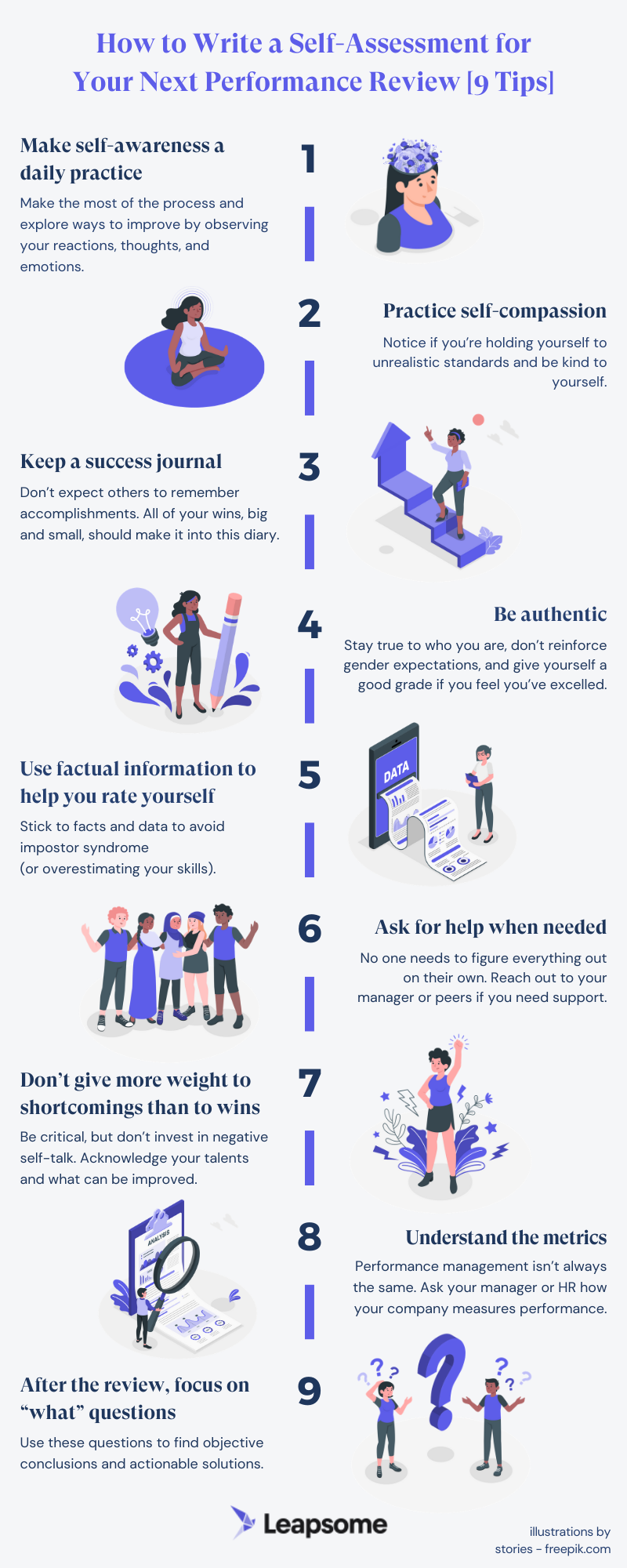
Self-assessments are equally important for employees and their managers. It's a chance for you to reflect on, as well as highlight aspects of your work and share feedback. While writing your self-assessment there's a couple of important aspects to keep in mind that we have outlined below.
Play to your strengtht
An extra benefit of self-assessments is appreciating what you do exceptionally well. This will help you gain more clarity on what tasks you enjoy the most and use constructive feedback in your favor.
Having a conversation about your strengths can make way for projects where you’ll have the opportunity to put your top skills to use. This can be your chance to achieve even better results and find more enjoyment in what you do — Gallup data demonstrates that using your strengths at work can improve your levels of engagement up to six times and increase your productivity by 12.5%. Additionally, identifying what you’re good at is crucial for knowing what to take in if you receive harsh feedback.
Aim for self-awareness
“Personal growth is closely linked to self-awareness, as reflection helps us be more attentive to underlying values, own biases, subjective perception, and situational behavior.”
— Sophie Schönicke, Coach & People Enthusiast
Put simply, self-awareness means being conscious of your personality, actions, thoughts, and emotions.
Making it part of your self-evaluation can help you make the most of the process and take action for improvement. Claudia Braun suggests that we also observe how we treat ourselves:
“What is your inner reaction when you notice that you made a mistake or could have done something better or faster? Is there an element of beating yourself up (as in ‘Idiot, how did I not consider X, Y, Z?’), or is there an attitude of interest — ‘Oh, let me understand what happened here. There is certainly something I can learn!’”
Practicing self-awareness has the potential to improve your life beyond your job.
Be humble, but authentic
Staying true to yourself should be your main priority during self-assessments. This means not showing off, not humble-bragging, but also not diminishing your skills. Don’t be afraid of giving yourself an outstanding grade if you feel you’ve excelled in a particular area.
To avoid impostor syndrome (and avoid underestimating your skills), provide factual information and data when rating yourself. You did a great job launching a new project at work? Don’t count on your manager remembering each of your wins — make sure to include them in your review.
Keeping a success journal is a great way to ensure you also don’t forget what you’ve accomplished. No matter how big or small, each win should make it into this diary, which will help you when it’s time for your performance appraisal.
Although it may feel odd at first, we must train ourselves not to give more weight to shortcomings than to accomplishments. Chances are, you’ve learned to excel in negative self-talk over the years and not to acknowledge your talents.
This is especially pervasive if you identify as a woman and/or are part of a marginalized community — in which case, you might also be dealing with unconscious bias in performance reviews from managers and colleagues in privileged positions. On a similar note, be careful not to reinforce toxic gender expectations that dictate, for instance, that men can’t be too soft and women must be docile.
All in all, be honest about your strong skills while considering how you could apply them for professional development in other areas. There is no such thing as perfection, and you shouldn’t be expected to figure everything out on your own. Ask for help when needed — you might be setting a great example and helping advance workplace culture.
Understand how your company measures performance
There are different performance management methods, and not every employer follows the same metric in 360° reviews. Even if grades seem to be the same (e.g., 0-10, 1-5), benchmarks may differ. For instance, 3 would indicate average performance within some metrics, but we recommend a system in which 3 stands for meeting all expectations (or 100%).
Make sure to get informed before starting your self-assessment. This way, you won’t be at risk of assigning yourself grades that don’t correspond to your self-evaluation. Additionally, you won’t be startled if you receive a rating that seems very low, but according to your company’s system, reflects a better evaluation than you thought.
After the review, focus on the “what”
If you’re anxious about your self-assessment and performance review, this feeling may not immediately go away after your development talk with your manager. For many, negative self-talk and rumination kick in after the process — but this is not the way to go about change.
Taking actionable steps for improvement
You might have come across Simon Sinek’s “Golden Circle.” This framework suggests that organizations must know their purpose (the “why”) before exploring “how” they aim to achieve the “what” (products or services). Focusing on the “why” is a tried-and-tested path to successful entrepreneurship. But when approaching our performance reviews, we’re looking to first focus on the “what.”
Consider this situation: a new position opens at your company, which could be your chance to get promoted and take on more responsibility. However, you don’t voice your wants and expect your manager to promote you if they think you have sufficient skills. In the end, a new person gets hired for the position. As you discuss your 360° review, you and your manager determine that you would be ready to take on more responsibilities, but the position is no longer available.
As argued, practicing self-awareness is essential, and unearthing why we have certain behaviors is important for change. However, focusing on “why” questions at this time (“why didn’t my manager see my skills before?” or “why didn’t I believe in myself?”) might make you blame yourself and doubt your potential even more. It will bring no resolution. What you need is to pave the way for the next steps in your career path.
In contrast, “what” questions can be valuable tools to digest your performance review. They have the potential to provide objective conclusions and point toward actionable solutions. A “what” question such as “what can I do, given my circumstances today, to advance my career?” focuses on the present and what can be done to improve a situation.
Additionally, Claudia Braun recommends that we use “what” questions to dig deeper.
“If we truly and sustainably want to change behavior and develop ourselves, it’s very useful not to stop with self-awareness at our behavior and how others perceive it, but also understand what is driving our behavior, namely thoughts and emotions and — if you want to go even deeper — needs and fears. One very effective way of training self-awareness on these different levels is mindfulness and meditation.”
🎯 Curious how Leapsome can improve performance reviews?
We help over 1,000 different companies build review processes that employees love.
👉 Let’s discuss how we can help you
Personal and professional development
Getting to know ourselves is a lifelong endeavor, and each step will help you perceive what you can do to improve in different areas of your life. Hopefully, you’ll practice self-compassion along the way and accept that external circumstances can impact your performance. Whichever direction results go, they don’t determine who you are, but they can help you grow into who you want to be.
The next time you’re asked to fill out a self-assessment for a performance review, remember that this process is your ally and that self-development can be an exciting and gratifying journey.
If you’re an HR or People Ops professional who would like to learn more about how Leapsome can help your team with self-assessments, book a demo with one of our product experts.
Streamline performance reviews and employee growth with Lepasome
Writing a strong self-evaluation is easier when everyone works with clear goals, ongoing feedback, and a consistent review process. Without that structure, self-assessment and performance conversations fall into recency bias and lose sight of the journey it took to get where you are now.
Leapsome helps teams give self-evaluations more structure so they become more meaningful and actionable. Employees can reflect on goals, feedback, competences, and previous review cycles from one connected HRIS and people management platform, making data collection easy for stronger self-evaluations. Managers get better context before those conversations happen, and HR teams build a process that supports development.
With Leapsome, performance reviews become part of everyone’s continuous growth instead of just another administrative cycle.
“By collecting feedback throughout the different review cycles, we can promote this culture of listening. In June, we ran company-wide 360° reviews, and everyone started self-assessing, providing feedback to managers, and receiving feedback from managers and peers. It’s this really great moment. I really like the process of taking a look at yourself and understanding your strengths and your opportunities to develop even more. It’s also always very rewarding to be able to provide feedback to the people around you as well.” — Victor Tomas, Learning and Development Specialist at Swapfiets
📈 Build better self-evaluations from the start
Leapsome’s HRIS and people management platform connects goals, feedback, and HR data in one place, so employees can self-reflect with confidence and managers can turn performance conversations into growth plans.
👉 Request a demo
FAQ
What are some examples of self-evaluation answers for performance reviews?
Self-evaluation answers should be specific to the question, honest, and include solid examples. They should explain what you achieved and what you learned from the challenges that appeared along the way. If the review asks about strengths, focus performance phrases on clear contributions, and if it asks about development areas, take ownership without turning it into an apology.
Some examples include:
- In Q3, I improved our onboarding handoff by documenting key steps for each role and clarifying task ownership between teams. This helped new hires get answers faster and reduced repeated questions for managers.
- I’m proud of how I handled the client escalation in March. I documented the issue clearly, kept the team updated with regular check-ins, and helped us agree on next steps to protect the relationship before it strained further.
- One of my strengths this cycle was follow-through. I kept the project timeline visible, flagged risks early, and helped the team stay aligned when our priorities changed.
- I want to improve how I manage competing priorities. Sometimes I say yes before checking existing deadlines. By the next review cycle, I want to confirm priorities with my manager earlier so I can protect the quality of my work.
In your self-evaluation, keep away from a simple task list, and focus on the impact your work made.
Leapsome Team





%20(1).jpg)