OKRs vs. KPIs: Supporting growth by thinking ahead and looking back


If you’re part of a fast-growing organization, you likely use key performance indicators (KPIs) to see how departments and teams are progressing with their projects and goals. You might also monitor KPIs to track shifting metrics like profit margins, turnover rates, and customer retention rates.
On top of that, you’ve probably also been tasked with implementing objectives and key results (OKRs), as the OKR framework has proven to be a powerful tool for companies that want to set and reach ambitious business targets.
Still, as projects ramp up and team workloads fill to capacity, tracking so many metrics can become overwhelming. It might prompt leadership to ask: Are both goal-setting processes necessary? When your company has ambitious operational objectives and growth goals to achieve, which framework should you prioritize? Is it really a matter of OKR vs. KPI?
It may seem advisable to choose one approach over the other, but that might put your company in the same camp as the 42% of organizations whose employees rate their goal-setting processes as “bad.”*
The truth is that OKRs and KPIs are both helpful goal-setting strategies. To educate your team in using them effectively, you need to know how each approach works, how they differ, and how you can use them to inform each other. You should also research examples and best practices for implementing OKRs and KPIs and increasing company-wide alignment.
That’s why in this guide, we explore:
- How OKRs versus KPIs work
- Examples of OKRs versus KPIs
- The key difference between KPIs and OKRs
- When to use OKRs versus KPIs
- Best practices for working with OKRs versus KPIs
- Common mistakes to avoid
We also provide you with an at-a-glance infographic you can share with your team to explain the difference between these two metrics.
*Leapsome State of People Enablement, 2023
🔥 Leapsome is the key to getting the results you want
Use AI to generate OKRs quickly and make meaningful progress on your goals.
👉 Discover Leapsome Goals
What is a KPI?
A KPI is a basic success metric that helps individuals, teams, and companies track progress toward a distinct result. When setting specific goals, key performance indicators are an effective method for creating a set of detailed outputs to focus on. The great thing about KPIs vs OKRs is that they help people track essential metrics more efficiently and can work for any organization or department — whether it’s sales, marketing, operations, HR, or IT.
However, it’s worth noting that KPIs can show how you’re performing at a specific time but don’t provide much information regarding your progress; you need to put them in the proper context to drive the desired outcomes.
Let’s look at an example of a KPI to better understand what they are and how they function.
KPI example
Let’s say your CEO asks your Head of People Ops, “How often and how quickly are employees leaving our company?” Your Head of People Ops can easily find this figure because it’s one of the metrics they consistently track: your company’s employee turnover rate, which is currently 19%. They decide to set a KPI target of 12% aimed at reducing churn.
In this example, the employee turnover rate is the KPI. It’s one among many KPIs your people ops team tracks, alongside key performance indicators like absenteeism rates, the number of overtime hours worked, and employee satisfaction.
What is an OKR?
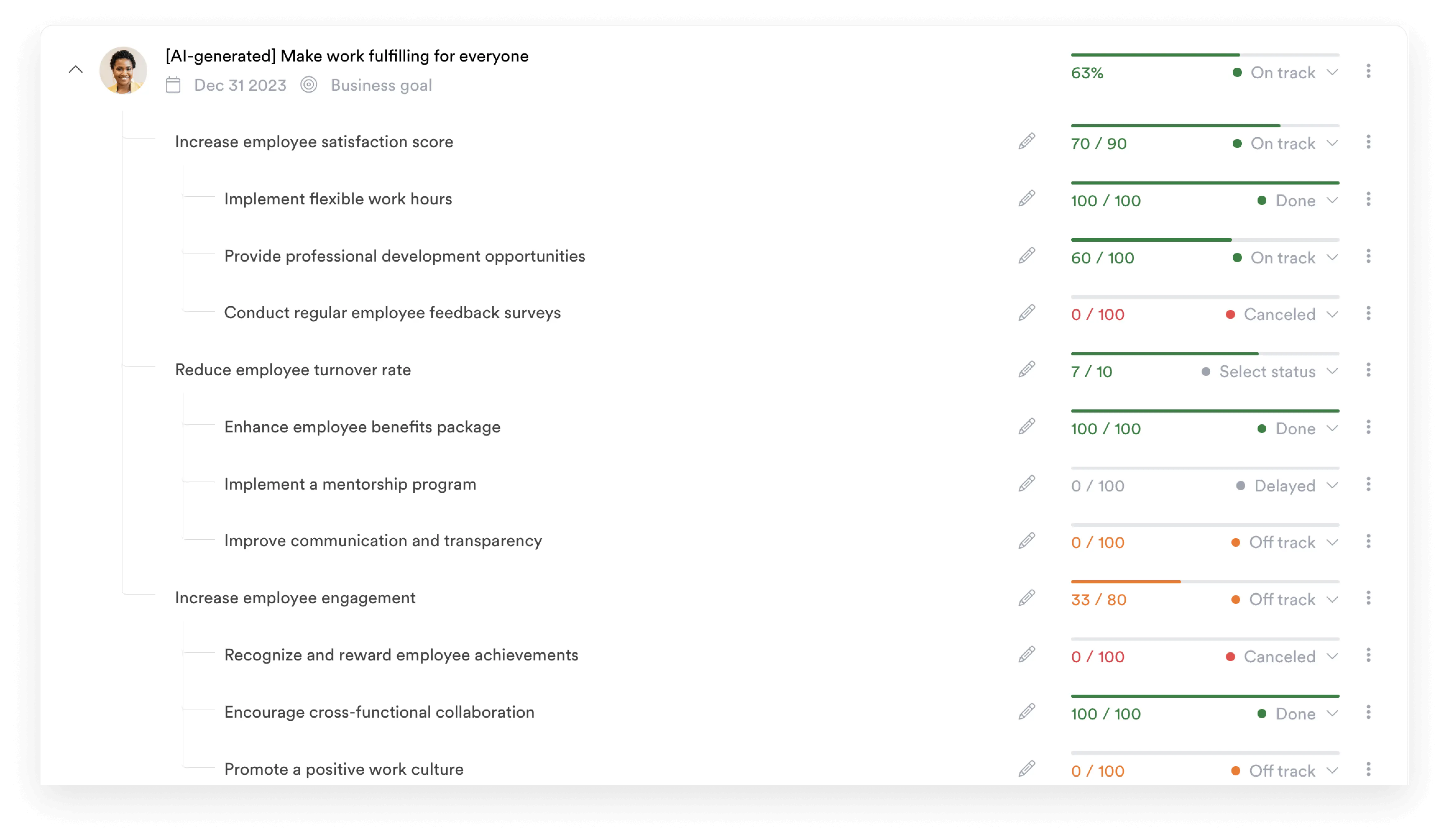
An OKR is a goal-setting strategy with two fundamental components: objectives and key results. While an objective is a goal that a company, team, or individual wants to achieve within a defined period, key results are the quantitative metrics that show when you’ve completed the objective. For every objective, you should have three to five key results.
You may have heard that you should shoot for ambitious objectives — and that’s true. However, it’s even more essential to make your objectives easy to understand, motivating, and aligned with your company’s mission and strategic goals for the future. Similarly, key results should be measurable and time-bound. That way, it’s easier to create OKRs that cascade from the top of the company down — also called cascading goals — and develop initiatives, on team and individual levels, that will push the OKRs over the finish line.
Key result vs. KPI
Be careful not to confuse key results with KPIs, as they serve different purposes. A KPI is a basic achievement metric, and you might incorporate them into key results to make them more measurable and outcome-driven. For instance, if you want to improve your eNPS score, your KPI could be your eNPS, and your full key result might be to increase your average eNPS from 20 to 30.
Now, let’s look at the example below to get a better picture of what OKRs are and how they work.
OKR example
In this OKR example, you’re the Head of Sales, and one of your department initiatives is to convert more prospects into leads. So, you make “increasing the number of qualified leads” your objective, and your leadership team collaborates to come up with three key results:
Objective | We optimize our sales process within the next two quarters to reduce the time from sales inquiry to qualified lead.
- Key result 1 | We reduced the number of steps in the demo request process by 30%.
- Key result 2 | We created a system that empowers the sales team to run demos with 15 new leads every week.
- Key result 3 | Sales team members answer 70% of sales inquiries within 12 hours.
“OKR and KPI frameworks must first be understood by every responsible and accountable team member at some level before they can be implemented effectively. Once a team, department, or company are all on the same page in terms of what OKRs and KPIs are (and have had a chance to discuss and collaborate), there’s a shared fate and purpose in place that lets those teams all operate together effectively.”
— Erik Harbison, President and Co-Founder of The Marketing Help
OKR vs KPI: Key differences

We’ve explained the difference between OKRs and KPIs in theory, but what is the difference between OKRs and KPIs when using them in practice? When thinking about KPI vs OKR, it’s not a matter of reaching for one or the other — they can complement each other.
Knowing the differences between OKRs vs KPIs ensures that you use both effectively as part of a holistic goal-setting strategy.
Let’s unpack the idea of “KPI vs OKR” to illustrate what we mean:
- KPIs are raw performance metrics that tell you how your business performs, while an OKR is a framework for goal setting — When building your OKRs, you’ll determine what KPIs you’ll need to track your progress toward your objective.
- OKRs are always future-oriented, while KPIs tell you how you’re doing at present and in the past — That’s why relying on KPIs alone to measure your business performance won’t help you move the needle forward over time.
- KPIs don’t change; OKRs do (and regularly) — You may change what KPIs you rely on as your goals shift over time, but the KPIs themselves remain constant.
- KPIs are standard benchmarks that departments and organizations use within industries. Your OKRs should be unique to your company and mission — You may draw goal-setting inspiration from your competitors or industry peers, but your key results should reflect the specific outcomes your company needs to realize.
- KPIs communicate an opportunity or issue, while OKRs provide a framework to address them — If your employee absenteeism rate is high, it may be time to create an objective focused on increasing employee engagement.
When to use OKRs vs. KPIs
You’ll use both OKRs and KPIs to build a complete picture of organizational performance. But choosing the right one for a specific goal is less about picking your favorite strategy and more about understanding the scale and perspective your company needs.
Company size can change what OKRs and KPIs are able to accomplish. Small and mid-sized companies lack the massive resources of enterprise competitors, so they need to use OKRs and KPIs together to monitor day-to-day business health while making big growth moves.
High-performing HR leaders don’t choose between growth and stability. Here are a few examples of when to use OKRs and when KPIs are a better fit.
When to use OKRs
OKRs drive transformation. They serve as the growth engine when your organization needs to change its trajectory. Use them to:
- Set ambitious strategic goals: Push your team toward targets with OKRs that require them to work in new ways.
- Execute time-bound initiatives: OKRs provide the necessary structure for projects with strict deadlines, like entering a new market or launching a product feature.
- Get poorly performing teams back up to speed: Targeted OKRs apply concentrated pressure to departments that consistently fall behind.
- Drive alignment and focus: Specific OKRs help distributed teams see exactly how their daily tasks impact the core company mission.
When to use KPIs
KPIs anchor your company and keep operations steady while you scale. They focus on what’s already happened, so you can compare your progress over time. KPIs work well for the following tasks:
- Monitoring ongoing business health: Use KPIs like employee turnover, absenteeism, and profit margins to keep the pulse of your organization. The HR Research Institute’s State of People Analytics shows that 57% of organizations believe great analytics improve their business outcomes and allow leaders to make more strategic decisions.
- Enabling continuous tracking: KPIs provide the raw data you need to measure where you are now against where you were a few weeks or months ago. Unlike OKRs, they aren’t tethered to a specific goal, so they can give you more evergreen information.
- Maintaining performance levels: A dip in KPIs can serve as an early warning system that alerts leadership before a minor drop in productivity becomes a systemic issue.
- Measuring individual performance: These metrics offer an objective way to see if team members meet the fundamental requirements of their roles before they’re assigned to complex projects or move up the ladder.
OKRs: Best practices and common mistakes

According to OKR International’s research, 90% of organizations use OKRs as a strategic framework. This adoption rate (which OKR International points out has increased notably over the last few years) suggests that OKRs are becoming the standard for business growth.
However, high adoption rates can create a false sense of security: Just having OKRs isn’t enough to drive organizational growth. Our 2023 State of People Enablement report found that this passive mindset leads to a 42% failure rate in goal-setting satisfaction.Real success comes from operational rhythms that turn a list of goals into tangible results. Here’s what to do and what to avoid when using OKRs.
Best practices for OKRs
- Give your employees time to learn, absorb, and workshop their OKRs before they set them — Sometimes, OKRs take a couple of tries to get right. Work with your staff members to experiment and play around with some ideas before officially establishing their OKRs.
- Make your objectives ambitious, but your key results specific and attainable — Your key results are the action steps allowing you to reach your goals. If you make them too hard to reach, you’ll be less likely to achieve your objectives.
- Register your OKRs with a system everyone can access — The goal isn’t to micromanage your people but to facilitate collaboration and accountability. This is where an OKR setting and tracking software can help. Organizations use Leapsome’s OKR software, for example, to keep their OKRs in a centralized space where they can set them, collaborate on them, track them, and report on them.
- Schedule regular OKR check-in meetings with your staff — We recommend running OKR check-ins biweekly or monthly. That’s often enough to ensure accountability and give everyone time to review progress and priorities.
OKRs: What to avoid
- Not setting a time frame for each OKR — Having a deadline for your goals makes tracking and achieving them easier.
- Drawing inspiration too closely from your competitors — Your competitors may move in the same industry, but they most likely don’t share your strategic vision nor face the exact same challenges.
- Not checking OKRs regularly — It often happens that companies set and forget their OKRs. Setting OKRs is a good starting point, but you won’t make progress without regular check-ins and revisions.
- No communication between managers and employees about OKR progress — It’s a manager’s responsibility to help reports set OKRs — but after that, it should be a shared effort. Managers must encourage their teams to take initiative with their OKR upkeep.
🔎 Transparency and communication about goals should be a part of the process
Leapsome Goals can help. Our platform lets you leave comments, provide context, and discuss goal progress.
👉 Learn more
KPIs: Best practices and common mistakes
Organizations that implement KPIs are 19 times more likely to be profitable compared to those relying on gut feeling, according to McKinsey & Company. When you collect random data points instead of monitoring metrics directly related to your goals, it’s much harder to identify what went right and replicate your success. High-performing teams use these performance benchmarks to build predictable growth and reflect in the following ways.KPI best practices
Best practices for KPIs
- Schedule regular KPI check-ins — Ensure every department understands which KPIs are essential to success, and designate someone who will review them regularly.
- Make your KPIs transparent in your organization — Making company KPIs available for everyone doesn’t just help with cross-departmental alignment. It makes accountability easier, too.
- Incentivize hitting KPIs — Put your employee rewards and recognition program to work. Offer monetary or non-monetary rewards to employees or teams that consistently meet or exceed their KPIs.
- Use your KPIs to discover where to improve and set your OKRs accordingly — If you have difficulty meeting one of your KPIs, you can address that issue with your next OKR. And if you regularly have a hard time meeting your KPIs, you may need to reassess them.
KPIs: What to avoid
- Tracking KPIs without your OKRs in mind — You may, for example, have noticed a decrease in absenteeism over two months. That’s great! But is the decrease significant enough to get you closer to your objective of reducing your absenteeism rate by 2%?
- Measuring KPIs without taking action — If you notice a KPI heading in the wrong direction, don’t wait. Flukes happen, but you shouldn’t count on them; it’s best to diagnose and address issues before they get out of hand. You can also investigate when KPIs are on track so you can replicate what’s working.
- Too much reliance on industry norms — Industry targets are helpful to a point, but they may not help growing companies. Keep them in mind when setting your own KPI targets, but don’t make them your sole guide.
- Not celebrating KPI wins — Celebrating wins is essential for boosting morale and motivating your employees. KPI wins are always worth celebrating, even if it means a quick announcement in your company’s Slack channel.
Improve your KPIs & meet OKRs with Leapsome
.png)
Educating your leadership and teams about the differences between OKRs and KPIs is crucial to get buy-in and generate effective, sustainable outcomes. Still, once you have company-wide support, where will you record and track your KPIs or OKRs for easier collaboration and transparency?
That’s where Leapsome comes in. Our platform makes it intuitive for companies to set goals they can align all their people behind, and our tools ensure it’s simple for teams to analyze and track their progress. Use Leapsome Goals to set OKRs quickly with generative AI, That’s where Leapsome comes in. Our all-in HRIS and people management platform makes it intuitive for companies to set goals they can align all their people behind, and our analytics tools ensure it’s simple for teams to analyze and track progress. Use Leapsome Goals to set OKRs quickly with generative AI, collaborate on them asynchronously with notes and feedback, and customize them so they align with your company’s overall targets. Goals also integrates with Leapsome Reviews, Meetings, and Instant Feedback so you can support team members with meeting their own professional objectives and recognize them for hard work.
🔥 Get the key results you want with Leapsome
With our flexible processes and frameworks, you can make better progress on the goals that matter.
👉 Talk to one of our experts
FAQs about OKRs vs. KPIs
Should you have OKRs & KPIs?
Yes, you should have both objectives and key results (OKRs) and key performance indicators (KPIs) — you need both to drive outcomes and measure success. If you have OKRs but no KPIs, you’ll have a goal and direction for your work but no metrics to show if you’re on the right track. If you have KPIs without OKRs, you won’t know if your success metrics are getting you where you want to go.
For example, if one of your company’s OKRs is to reduce employee turnover, you can use KPIs to help you create a roadmap to get there. If you use employee attrition as a KPI, your first key result could be reducing employee attrition from 25% to 17%. Your second KPI could be your eNPS, with a key result of increasing your eNPS from 10 to 20.
Can OKRs replace KPIs?
No, objectives and key results (OKRs) cannot replace key performance indicators (KPIs). It’s not a matter of OKR vs KPI — rather, OKRs can encompass KPIs. Let’s illustrate this with an example.
Let’s say you want your social media team to increase your company’s brand recognition. So you come up with a few OKRs, like the following:
Objective | Our brand has become so well-recognized by Q1 of next year that we can scale back our paid content strategy.
- Key result 1 | LinkedIn engagement increases from 25% to 40%.
In this example, your KPI would be LinkedIn engagement. So, while necessary, KPIs are incomplete unless you put them to use in your OKR structure.
Why are OKRs better than KPIs?
Objective and key results (OKRs) aren’t necessarily better than key performance indicators (KPIs), but they are more comprehensive. KPIs are independent metrics, and you can use them to build effective OKRs. Examples of KPIs might be social media engagement, customer retention, leads per month, conversion rate, or cost of materials, to name a few.
It sometimes happens that teams and leadership don’t fully understand the difference between OKRs and KPIs, or they lose sight of it.
Let’s say your marketing team’s OKR for the next quarter is to increase brand recognition. To meet this goal, your marketing team decides to increase their content output on LinkedIn because of social media KPIs they’ve utilized in the past. At the end of the quarter, they report that they’ve increased their content output but haven’t increased engagement; this is because they failed to align their KPIs with their objective (increasing brand recognition).
What are the four pillars of KPIs?
The four pillars of KPIs is one way to group your metrics into broad categories. Organizing KPIs makes it easier to conceptualize what parts of your business they affect. These pillars include:
- Financial performance: Focuses on profit margins, working capital, and ROI to understand how shareholders see the company.
- Customer satisfaction: Measures loyalty and retention through metrics like net promoter score and lifetime value to see the business through the customer’s eyes.
- Internal process quality: Evaluates operational efficiency and output quality using things like time to response and customer complaints to provide the best customer experience possible.
- Learning and growth: Monitors human capital, culture, and training hours to ensure the company can continue to improve and innovate.
What are the five elements of OKRs?
The five elements of OKRs give a high-level outline of the OKR-setting process rather than sorting the metrics themselves. In order, the elements are:
- Objectives: Set qualitative and ambitious goals that represent what the organization wants to achieve.
- Key results: Pick quantitative metrics that make it clear when a team completes an objective.
- Initiatives: Outline the tasks and projects necessary to achieve those goals.
- Alignment: Ensure each goal and supporting project connects to the broader company mission and strategic priorities.
- Regular check-ins: Establish and run frequent feedback loops to maintain accountability and address friction points as they come up.
Leapsome Team