Employee classification: Accurately labeling roles in the workplace


Disclaimer: This content is for general informational purposes only and does not constitute legal advice. Leapsome does not guarantee legal compliance and cannot confirm how specific situations would be assessed in court. If you're unsure how the requirements apply to your organization, please consult qualified legal counsel.
Employee classification sounds like an easy HR task. You decide whether someone is an employee or a contractor, record the employment type, and move on. But 30% of employers have misclassified at least one employee, and the damage rarely stays with the legal team.*
When employee classification is wrong, the whole organization’s systems run on bad instructions. A misclassified worker may receive the wrong tax forms and enter the wrong onboarding flow, leaving knowledge gaps that keep them from doing their best. HR builds headcount reports that look clean on paper, but misrepresent the workforce in practice. So, a task that looked like an easy choice between contractor versus employee classification creates operational consequences long before it shows up in an audit.
This guide explains what employee classification means and why HR teams need to manage classification as a workforce planning decision, not just a compliance checkbox.
* Deel, 2026
What’s employee classification?
Employee classification is how an organization defines a worker’s employment relationship. It determines how the company handles pay, legal obligations, and employee recordkeeping. This isn’t quite the same as job classification, which groups roles by level or responsibility.
Common employment types
Most organizations sort workers into one of a few employee types, each coming with its own HR rules and risks.
Full-time employees
The IRS defines a full-time employee as someone who works an average of at least 30 hours per week or 130 hours per month. HR teams use that threshold to assess coverage obligations and keep benefits administration accurate, as full-time workers are covered under different legal standards than part-time workers.
Part-time employees
The Fair Labor Standards Act (FLSA) doesn’t set a federal hour threshold for part-time employees, other than “less than full-time.” Employers usually define part-time status in their own HR policies, but covered employees still get FLSA wage and overtime protections. HR teams need to set clear internal rules about what counts as part time, because part-time workers’ benefits differ from what full-time employees are typically offered.
Independent contractors
MBO Partners estimates that 72.9 million U.S. workers were independent contractors in 2025. Independent contractors aren’t employees under the FLSA, so classification depends on the working relationship rather than the label in a contract. If the company controls how, when, and where the person works, HR needs to reassess whether the worker is actually performing a contractor’s role, or if they’re an employee who isn’t getting the benefits they deserve.
Why employee classification influences more than compliance
Most employee classification guidance treats the topic like a legal glossary. Knowing what kinds of employees are covered under what laws is always a good starting point, but it doesn’t solve any of the operational problems HR teams face.
At its core, classification tells the organization how to treat a worker. It guides what development opportunities they can access and managers’ expectations. When that signal is wrong or inconsistent between systems, the operational drag cuts into productivity before any legal risk appears.
Here are a few areas that classification decisions affect.
Onboarding and employee setup
Classification shapes the first workflow a worker enters: onboarding. Full-time employees need deeper policy training and broader system access, while contractors usually get a narrower setup with clear project boundaries, as their role is limited to a specific task or set of tasks.
When HR uses one onboarding flow for every worker, the process ignores the employment relationship. Part-time employees don’t get clarity around their hours or where they need to be when, while contractors are flooded with information they won’t use, which can create access issues the people team has to fix later.
To make sure every worker starts their relationship with your organization on the right foot, build classification-specific onboarding paths, and connect each worker’s classification to their employee record during preboarding. That keeps sensitive information secure, doesn’t overwhelm part-time workers and contractors with more information than they need, and reduces the chance you’ll have to sink time into manual corrections later.
“If your HR systems don’t really talk to each other… you kind of have to pull this from your HRIS, this from your performance review, this from payroll… I think the trails break down a little bit.”
— Sammie Masley, People and Talent Partner at Leapsome
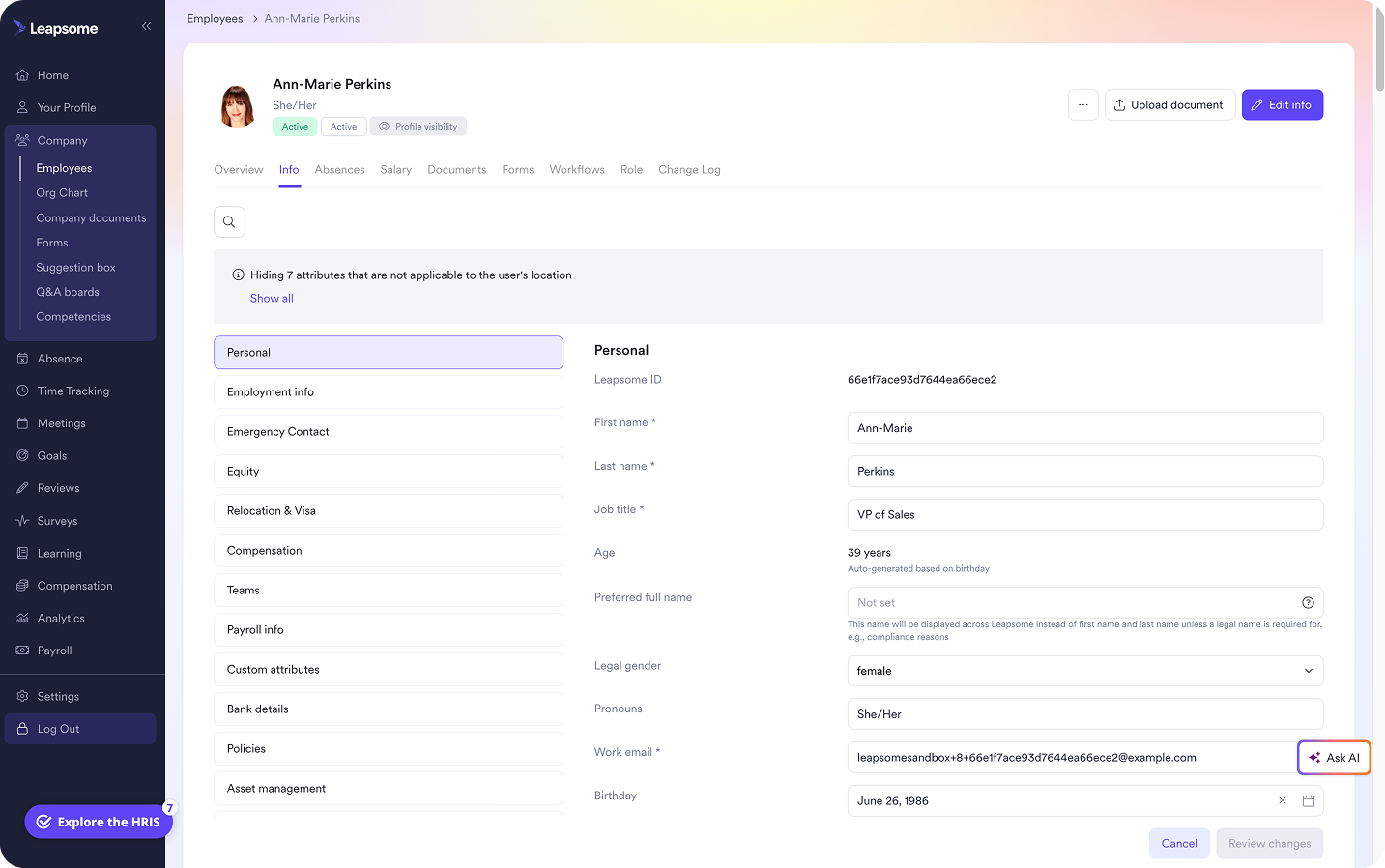
🖇️ Connect classification to the employee lifecycle
Leapsome’s HRIS and talent management platform links classification to employee records, so your people get the right workflows from their first day of onboarding onward.
👉 Explore Employee Records
Benefits and compensation
Classification affects what workers receive from the company and what protections apply to their role. When an employee gets misclassified as an independent contractor, their financial losses can be substantial. For example, the Economic Policy Institute’s estimate on 11 commonly misclassified jobs found that a misclassified construction worker could lose up to $20,399 in annual income and benefits, and a misclassified truck driver could lose up to $23,266 annually.
That misclassifying mistake doesn’t feel like a small recordkeeping issue to the person affected: Limiting their benefits access (even when unintentional) and pay can make a serious dent in their overall financial security. So, HR teams need to be careful, defining crystal-clear benefit rules and double-checking that all employee records accurately display employee status to protect their workers’ well-being.
Workforce flexibility and planning
Flexible labor can help companies scale without adding permanent headcount. That’s why more organizations rely on contingent workers like contractors during growth, hiring freezes, or demand spikes. A 2023 survey from Ceridian found that 80% of companies currently employ contingent workers, and 65% of those organizations planned to increase their use of contingent workers within two years, for instance.
But when HR loses visibility over who’s actually doing what, that flexibility can turn into a planning nightmare. A department may rely on part-time employees and still plan capacity as if everyone works full time, pushing those employees toward burnout without giving them the benefits they’re owed.
To avoid making hiring decisions with an incomplete view of workload, capacity, and future talent needs, HR teams should review classification data and workforce plans in tandem. This way, workloads stay balanced and the employee experience stays positive.
Performance management and employee development
Feedback should match the working relationship. A full-time employee may follow a structured quarterly review cycle to track their progress on hard and soft skills over long periods. A contractor usually needs project-based feedback tied to the work they agreed to deliver, not notes on their growth path.
Problems start when the organization doesn’t define those rules clearly. Managers worry they’re overstepping by giving independent contractors routines that don’t fit their working relationship if it’s not clear whether they’re a remote part-time worker or a contractor. Then, to try and reel it in, they accidentally leave traditional employees out of growth conversations because they don’t know who needs formal development support.
To support better work and useful feedback without blurring the employment relationship, HR should give managers simple guidance on what feedback looks like for each classification. Focus on immediate task-based feedback for contractors and broader development conversations for employees.
How to classify employees correctly and stay compliant
“Teams that are ready don’t just prepare before the audit, they prepare their day-to-day work… where they don’t have to do the preparation when it comes.”
— Erica Ancobia, CEO and Managing Director at KUNO
Correct employee classifications start with the work, not the label. A contractor can help out with specialized tasks, and temporary employees can support a team with uneven demand. But the classification still has to match the working relationship. When it doesn’t, HR creates a poor worker experience that doesn’t match the company’s obligations.
Here are some tips on how to accurately classify employees.
Understand the legal criteria for worker classification
“Leapsome is powerful enough to already know the local regulations that apply in your geography — and flags it if your setup isn’t compliant.”
— Suraj Paneru, Customer Success Coach at Leapsome
Before hiring an employee and assigning a classification label, HR teams need to review how the person will work. The IRS looks at the relationship between the worker and the business, including the level of control and independence in practice, when differentiating employees and contractors.
Setting the difference means answering a few practical questions early, including:
- Who controls how the work gets done?
- Does the person operate independently or follow company rules about when they work?
- Does the role need employee-level oversight?
The exact legal criteria varies by region, so reach out to legal counsel for advice when a classification isn’t perfectly clear.
Document classification decisions and supporting rationale
“You could have three different employee files, one in the system, one in Google Drive, and one on paper that could all be different.”
— Sammie Masley, People and Talent Partner at Leapsome
Classification decisions need a centralized system where HR can document why the worker was classified a certain way and keep the supporting details with the employee’s record. The decision may have come from the expected working relationship, approved hours, and contract terms.
If the role doesn’t play out as expected in practice, the notes mean HR team and managers understand the original logic instead of relying on memory. Both teams can then work together to either dial in their duties or reclassify them into a more accurate role. Those notes also point toward any misclassifications being a mistake, not planned or malicious non-compliance.
Review classifications regularly
A classification that made sense on day one may not fit six months later. For example, a temporary role may become part of the team’s long-term capacity plan when task quotas grow but headcount doesn’t scale accordingly. Regularly checking in with employees and contractors to see how their role has evolved keeps appropriate classifications from slipping into something that doesn’t fit.
Leapsome’s connected review cycles help HR see when responsibilities, workload, and development needs no longer match worker classification. Instead of relying on someone to spot the change (or for the worker to speak up), HR can review the role and update the employee record in the same system.
“Once it’s set up, everything runs automatically in the background. It might take hours to build, but then it just works smoothly and efficiently every time.”
— Suraj Paneru, Customer Success Coach, at Leapsome
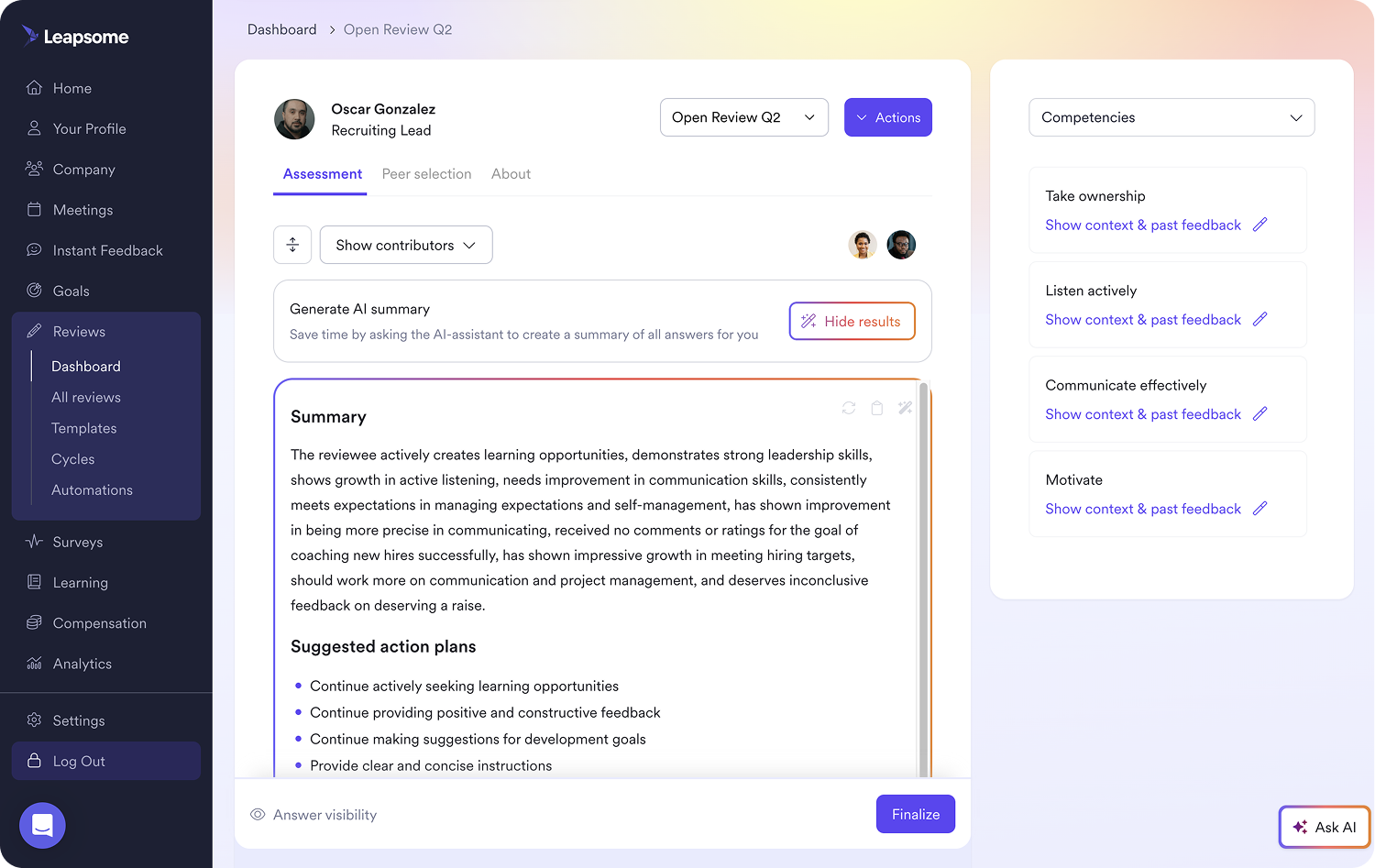
🎣 Use reviews to catch role drift
Leapsome puts Employee Records and Performance Review features in conversation with your notes, so HR teams can spot workload changes that suggest a contractor might actually be an employee.
👉 Explore Performance Reviews
Make workforce decisions with confidence using Leapsome
Legal risk is only the tip of the employee classification iceberg. Structural damage happens behind the scenes when the wrong classification shapes workflows, records, and workforce decisions.
A record that says “part-time” or “contractor” may satisfy documentation requirements. But it doesn’t give HR teams the insights they need for accurate planning when that label doesn’t connect to onboarding workflows, or when role changes don’t update across systems.
Leapsome helps HR teams turn static labels into a useful workforce signal. With clearer visibility into worker type, position change, and team capacity, HR can keep roles flexible as companies scale without losing control of the bigger picture.
With Leapsome, organizations can:
- Maintain accurate employee records: Keep classification data accurate everywhere through one connected HRIS.
- Connect records to lifecycle workflows: Link employee data with onboarding and performance processes.
- Improve workforce visibility and planning: See how different worker types support team capacity, and give leadership cleaner data before role drift creates bigger operational problems.
“Employees can now find everything in one place — their data, absences, goals, and reviews. I don’t have to explain which tool to use for what. It’s all in Leapsome.” — Merilyn L., Senior People Operations Specialist at Bob W.
🚦 Turn classification into a workforce signal
Leapsome connects employee records with lifecycle workflows, so HR teams can manage classification with more clarity as roles evolve.
👉 Request a demo