PTO vs. vacation time: A practical HR guide to leave policies

_under_300kb.jpg)
According to Pew Research Center, 62% of workers say it’s extremely important to have a job that offers paid time off (PTO). Strikingly, only 51% say the same about employer-paid health insurance.* So it’s vital to get this aspect of workforce planning and employee experience right.
Some organizations use general PTO policies, which give each employee a single bank of days they can use for any purpose. Others create vacation time quotas that live alongside other policies for sick leave and holiday time. And it’s common to start with one policy and later switch, either for operational reasons or to better align with shifting employee expectations.
The type of leave policy you choose has effects that ripple out far beyond mere compliance. They impact work-life balance, company culture, and retention. This guide explores PTO versus vacation policies to help you make an informed choice.
* Pew Research Center, 2023
What’s the difference between PTO and vacation time?
While the terms are sometimes used interchangeably, these two policies each have a distinct focus. Let’s start by looking at a breakdown of the key differences between PTO and vacation time systems.
How does PTO work?
A general PTO policy combines multiple leave types — including vacation time — under a single umbrella. Each employee can use their bank of paid leave at their discretion. PTO might be used for simple personal days, or for other common reasons like:
- Appointments
- Jury duty
- Errands
- Medical leave
- Bereavement leave
PTO is often accrual-based, where employees earn hours gradually based on pay periods or hours worked. Some organizations also allow employees to roll some accrued PTO over to the following year. Whatever the structure might be, this is the most common type of time off policy, used by 68% of employers according to SHRM.
How does vacation time work?
A vacation policy sets specific rules for paid leave that’s used for leisure and travel. Other types of time off, such as sick days, are tracked separately. That makes this type of policy less flexible than PTO, because it means employees have less say in how they use their leave allotments. They can’t generally move a vacation day to the sick day quota, even if they have plenty of the former but are short on the latter.
Which leave policy fits your workplace culture?
Leave policies don’t just influence how HR administers time off. They affect employee behavior, the way leaders manage, and overall organizational culture — which is why making the right choice is so important.
It’s easy to get hung up on exactly how much leave to offer your team. But ask yourself this question: "If employees don’t feel comfortable taking leave, does it matter how generous the policy is?" The answer is a resounding “no,” with Pew Research Center also reporting that less than half of employees actually use all the leave allotted to them.
Here are a few other good questions to think about when evaluating leave policies.
Does the policy truly encourage employees to take time off?
One APA survey found that only 40% of employees feel their company cultures respect time off. The gap between paid time offered and leave actually taken tends to come from everyday workplace signals, rather than the policies.
When managers work through their own vacations or constantly ping team members well after working hours, those actions set the tone for what’s actually expected. Even unlimited PTO can’t overcome a culture where taking time away doesn’t feel safe.
Can managers still plan work consistently?
Paid time off policies can reduce unscheduled absences by consolidating leave into a single bank, eliminating the “use it or lose it” mentality you get with limited sick days. However, that reduced workforce disruption comes with a tradeoff.
Depending on how your system works, managers may lose visibility into why someone is out — after all, a vacation day and a sick day look the same when they’re both lumped into the same bucket. That lost information can create scheduling and workforce distribution challenges.
Does the policy support long-term retention?
"Frequent or prolonged absences can be a real indicator of disengagement… Reporting to leadership helps spot patterns early and address them."
– Sophie O'Donoghue, Customer Success Coach at Leapsome
Most (if not all) employees want to take paid days off, and they prefer to do it on their own terms. When meaningful leave is hard to come by, employees are more likely to burn out, disengage, and ultimately look elsewhere for work.
On the other hand, when employees have the freedom to plan ahead and take flexible leave, they’re more likely to stick around. And they might even talk up your organization to talented peers.
The right tools can go a long way toward helping employees feel safe and in charge of their PTO. Leapsome makes it easy to structure time off transparently, and it gives HR and management real-time visibility into leave patterns and team availability.
"Managers can see who else is off, adjust requests, or approve directly. Everything is visualized in one place with full transparency."
– Suraj Paneru, Customer Success Coach at Leapsome
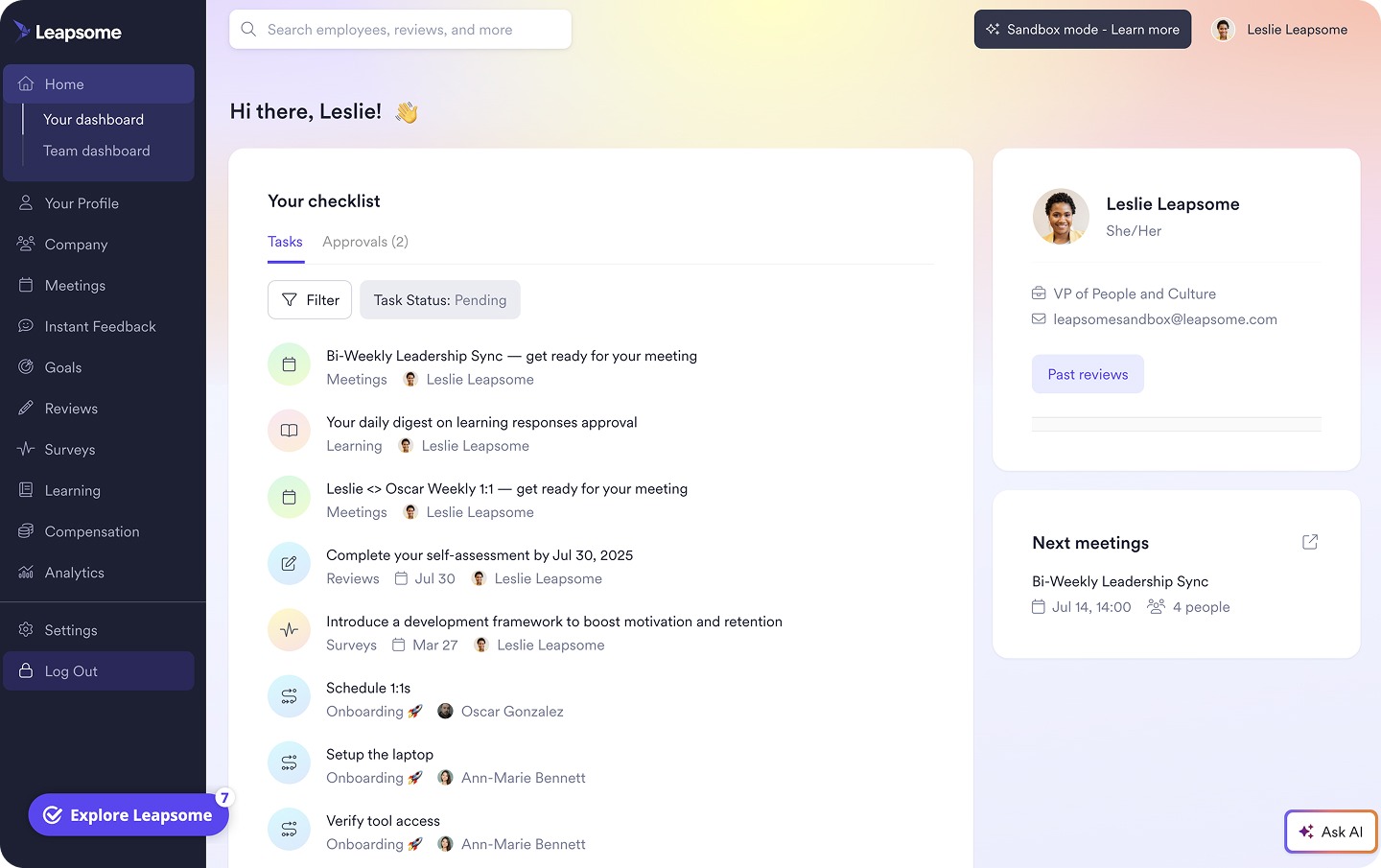
📅 Handle leave management in one consolidated platform
Give HR the power to manage leave policies from a centralized dashboard, and offer employees an intuitive self-service experience to maximize PTO planning freedom.
👉 Explore Absence Management
How to choose a leave policy that works for your company: Three steps
Your choice of leave policy should balance employee needs with operational realities. Here’s how to do that.
1. Evaluate your workforce and business needs
What does the law require, what does your workforce want, and what does the organization need? Many states and local governments have their own rules governing PTO, so that’s a good place to set your baseline.
"We even flag compliance risks — for example, if a country requires a minimum of 20 paid days off, the platform won't let you go below that."
– Suraj Paneru, Customer Success Coach at Leapsome
With compliance tucked away, think about employee needs like flexibility and psychological safety. You’ll want to balance these against wider business goals, such as maintaining adequate coverage and keeping admin overhead manageable.
2. Design policies employees will actually use
Even the best-laid leave policies fail if employees are afraid to take advantage of them. While you can try a softer approach, sometimes the simplest tactic is to make it mandatory to take a certain amount of time off each year.
This is also a good (but overlooked) way to give yourself a competitive advantage in recruitment. According to a Forbes Advisor survey, 31% of employees cite mandatory PTO as the most important benefit when looking for a job — employers didn’t even rate it in the top five.
3. Monitor policy effectiveness over time
Crafting an effective leave policy isn’t a one-and-done process. Track HR analytics like usage patterns and unscheduled absences, so you know how well your policy meets your objectives.
Of course, continuous improvement in this area can be a tall order if you’re grappling with disconnected software. Leapsome keeps things simple by connecting absence management with employee data.
"Managers shouldn't email HR to ask who's on leave or what a team's balances are; they should see it live. The moment people self-serve, interruptions drop and decisions speed up. That's the point of a single source of truth."
– Carolin Leidel, Consultant at torq.partners
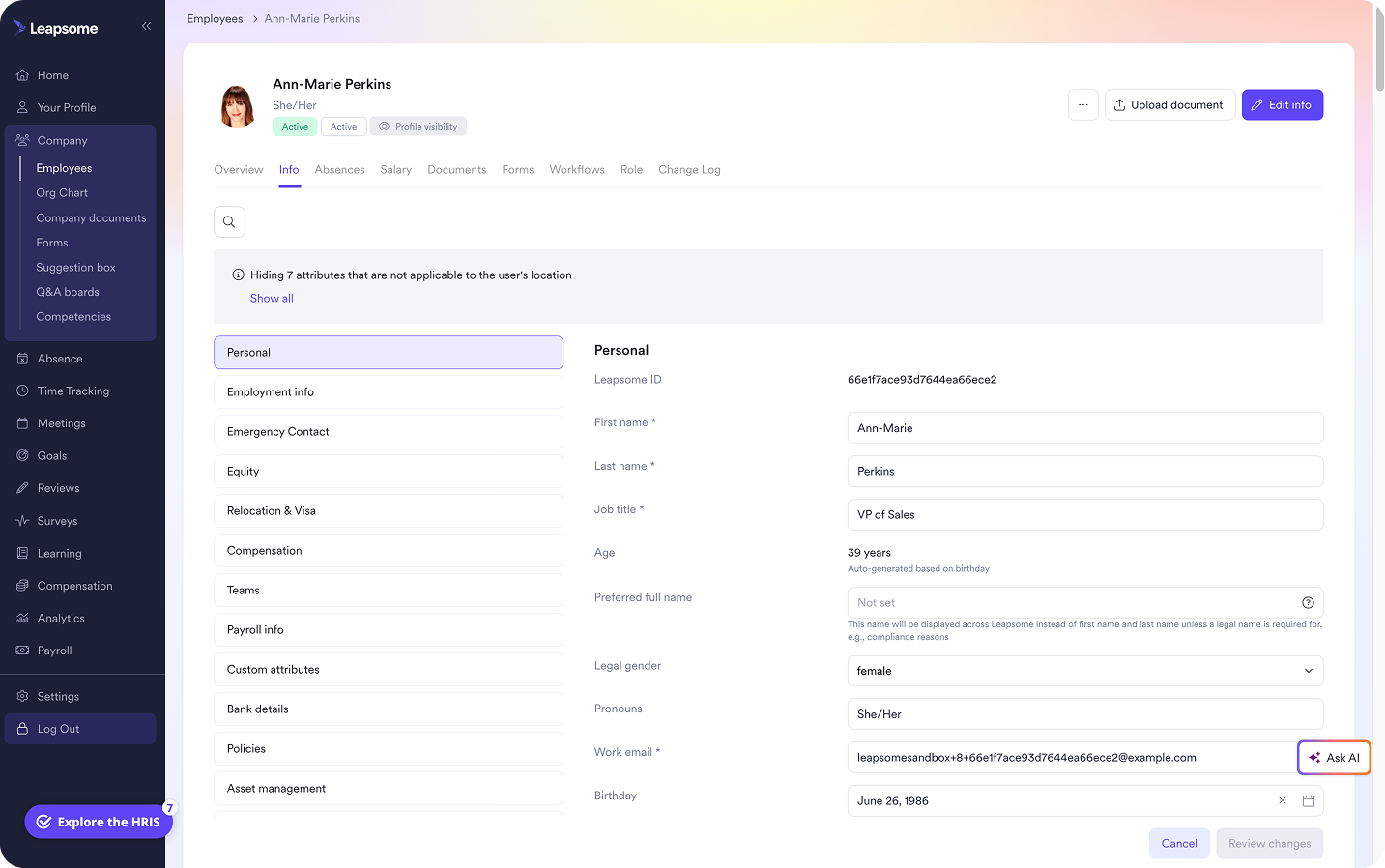
🔗 Unify employee records in a single source of truth
Centralize leave records and other team member data, so they stay accurate and connected throughout the employee lifecycle.
👉 Learn about Employee Records
Design and execute a healthy leave strategy with Leapsome
It’s an everyday challenge for many organizations: You invest time and resources into designing airtight leave policies, but struggle to make sure employees actually use their time off. On top of that, managers have a hard time navigating the system to plan work effectively around absences. The results are poor visibility and heightened risk of burnout.
With Leapsome’s HRIS and people management platform, your HR team can streamline leave management and improve workforce visibility. Managers approve self-service requests in one click, and the shared absence calendar lets everyone know who’s in and who’s out today at a glance. Add in advanced analytics linked to employee records, and you have a formula for consistent policy enforcement that promotes work-life balance and employee well-being.
“With Leapsome, we were able to automate performance reviews, goal setting, onboarding, and offboarding, and all together that helped us reduce our team’s manual effort by 20%.” – Weronika Czerny-Nowakowska, Chief Operating Officer at Neurons Lab
💪 Put your leave policy on digital rails
Leapsome lets you launch and govern your policy from a central command center, connecting employee data, absence requests and approvals, and everything else HR needs to get leave management right.
👉 Request a demo