

Hefty daily workloads are common for HR teams: According to our research here at Leapsome, the average HR professional now supports 53 employees.*
Your HR tools should reduce this burden; yet, many teams struggle with bloated technology, including multiple performance tools, overlapping survey platforms, and feedback that lives in siloed systems.
As a result, managers waste time switching between platforms, employees become confused about where to find information or complete tasks, and HR teams spend hours on manual data entry instead of focusing on strategic work.
In this guide, we’ll explain how to build an HR tech stack that brings together your core tools without friction. We’ll also share a framework for deciding when to consolidate and when to stick with specialist software.
*Leapsome, 2027
What is an HR tech stack (and what belongs in yours)?
Your HR tech stack is the collection of software your organization uses to manage HR processes across the employee lifecycle. A strong tech stack should empower your team to work efficiently, without forcing them to do extra manual steps or switch between platforms constantly.
Yet according to Gartner, 85% of HR teams struggle to work effectively due to fragmented tools and workflows. Let’s look at the essential categories in an HR tech stack and whether they can benefit from consolidation.
It’s easier to consolidate when you start with a platform that includes as many core HR tasks as possible. Leapsome’s all-in-one HRIS and people management platform gives you most of what you’ll need, then integrates natively with more niche HR tools.
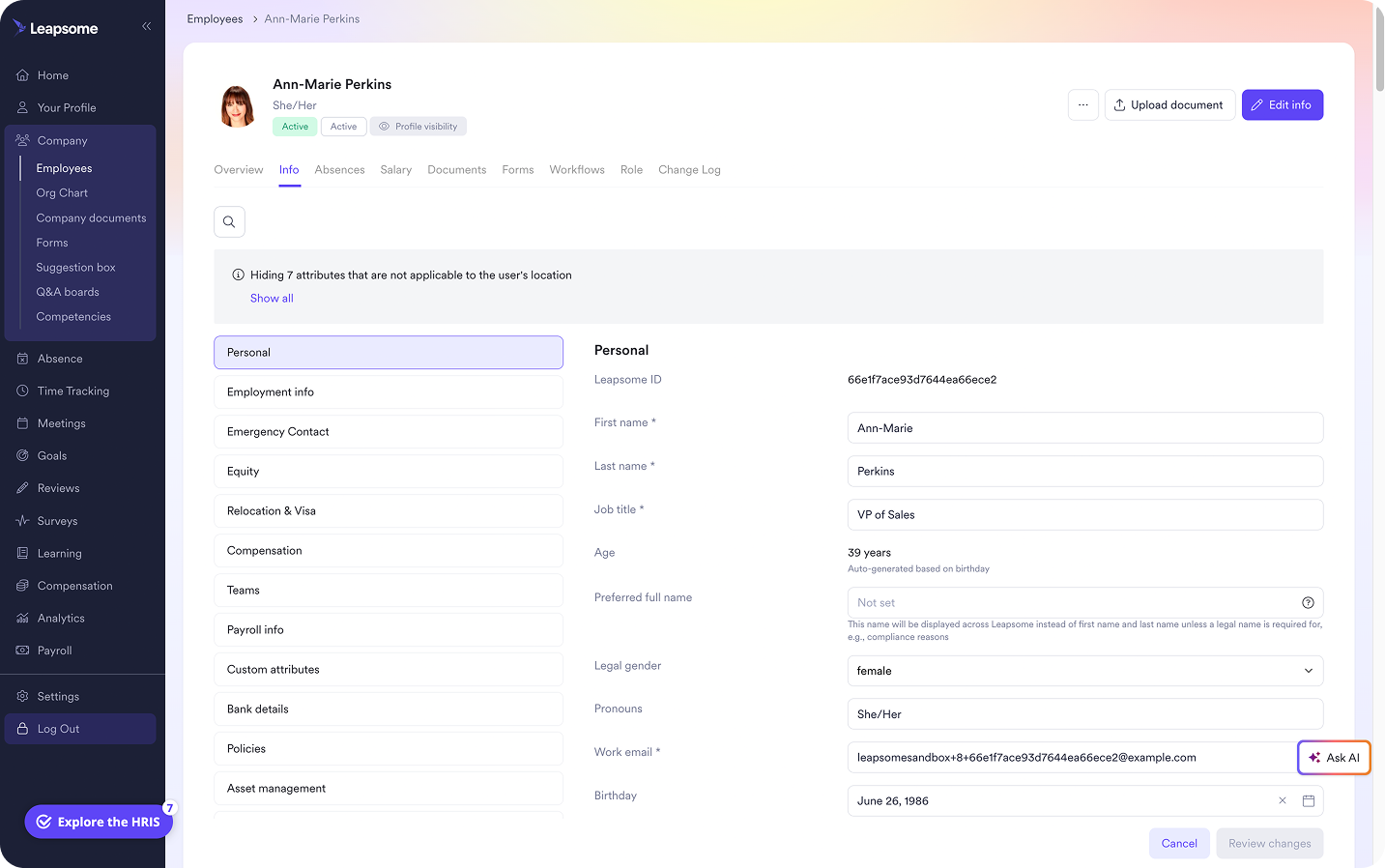
💡 See how an all-in-one HRIS reduces tech stack complexity
Leapsome connects core HR, performance, engagement, and learning in one platform, so your data flows where managers actually work.
👉Explore HRIS
Should you consolidate your HR tech stack?
"On the C-level, I learned to doubt people data because it arrived late and conflicted across files. Then, sitting in HR, I felt the pain from the inside and saw how much time went into rebuilding the same reports. Centralizing restores trust and your calendar." – Florian Klages, Managing Partner at torq.partners
The best way to decide between consolidated and specialist HR tools is by looking at your priorities. An all-in-one HR platform unifies core functions, so you don’t have to toggle between tools or re-enter data. This can save time and reduce errors, although since the platform serves many roles, individual features may lack some depth.
When you need more niche capabilities, you might want to keep a specialist tool around as well. HR teams often take a balanced approach, using core HR software plus specific tools for tasks like payroll and recruiting.
Here’s how to audit each tool you use now, so you can decide whether to keep or consolidate it:
- Does another platform do the same thing? If so, one of the tools needs to go. Platforms with overlapping capabilities can create confusion and inconsistent data.
- Does data reach your HRIS automatically? If HR has to make manual data updates or reconcile records, it’s usually best to integrate the tool or cover its function with another solution.
- Do managers and employees actually use the tool? If the answer is no, first find out why. The platform may be redundant or overly complex, in which case any necessary functions should be consolidated elsewhere.
- Does the business need depth the platform can't provide? If you need more powerful capabilities, you may want to add a specialized platform to your tech stack.
In some cases, choosing niche HR software makes sense. Organizations with workforces spread across multiple countries, and those with high-volume recruiting, may need dedicated solutions for payroll or hiring. Yet consolidating those tools with a comprehensive core platform like Leapsome can still make a big difference to resources spent and outcomes achieved.
"Look for one platform that covers your key needs and integrates with your stack. Don't scatter data across 10 or 20 disconnected tools." – Katerina Arsova, Head of People, Talent Operations, and Partnerships at Leapsome
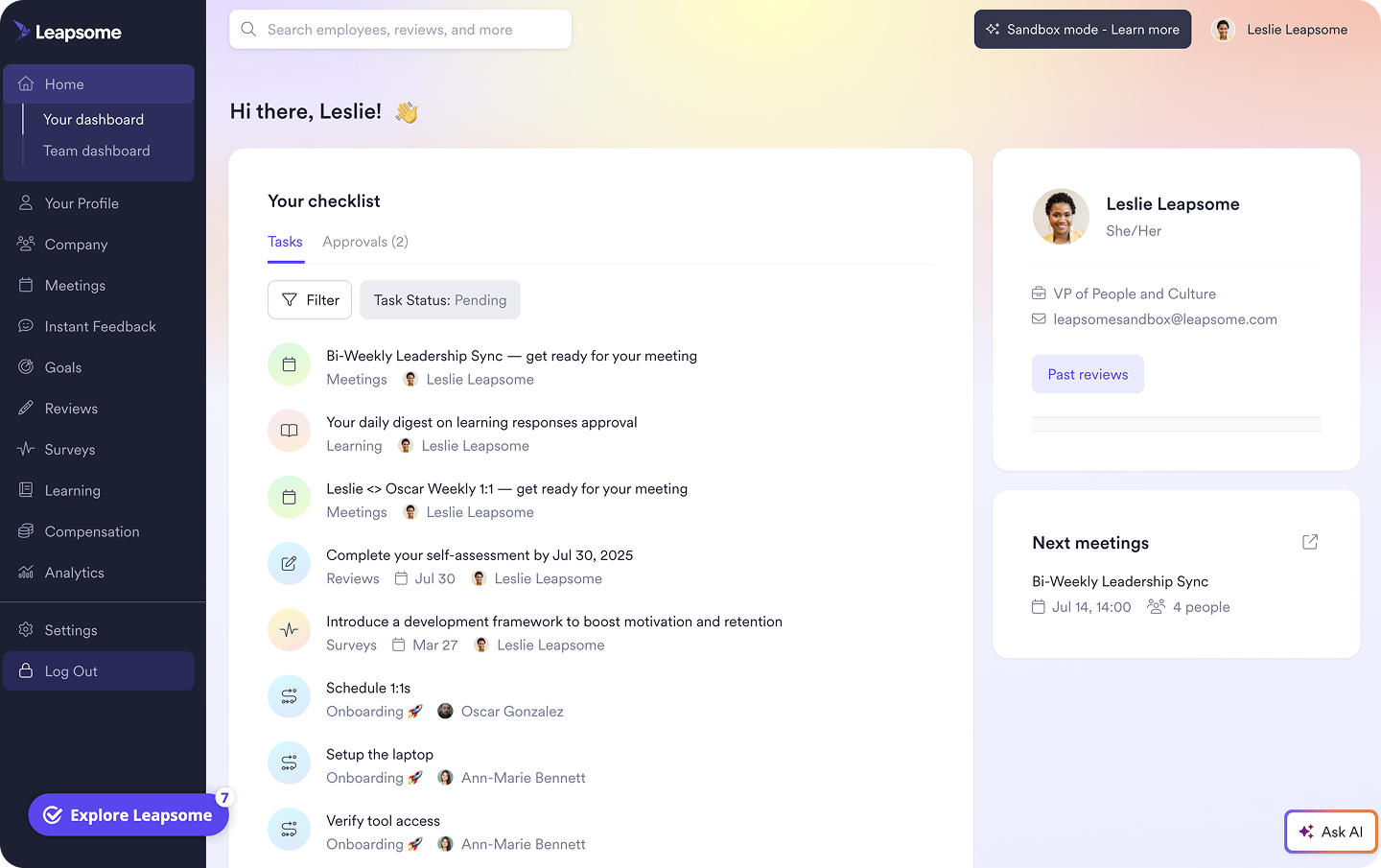
📊 Calculate the potential returns of consolidating
Leapsome’s ROI Calculator helps you estimate savings from reduced admin and tool maintenance, so you can build a business case for HR stack consolidation.
👉 Try the ROI Calculator
How to consolidate your full HR tech stack: A four-step roadmap
When consolidating your HR technology stack, take a tool-by-tool approach. Look for obvious duplicates, low adoption rates, and integration gaps, so you know which tools can be cleanly folded into your HRIS.
1. Map your tools and spot duplicates
List your current tools by category — HRIS, performance management, employee engagement, learning management, compensation, and analytics — and look for obvious overlaps. If you have two survey tools or multiple performance review systems, that’s a clear opportunity for consolidation.
2. Identify what people actually use
Ask managers which systems they engage with versus which ones are essentially ignored. Look for workarounds — are people maintaining parallel spreadsheets or giving feedback over Slack because your paid tools are too clunky? In our experience, HR teams are often surprised by the gap between "tools we pay for" and "tools people use," and find it informative when deciding which systems are worth keeping.
3. Calculate the cost of staying disconnected
By consolidating tools, you can significantly improve your HR ROI. Audit your total HR software spend to see how you could benefit, including:
- Duplicate data entry: Look at hours spent on manual reporting and duplicate data entry. If you’re spending 10–15 hours per week on tasks that could be integrated or automated, that's 500–750 hours lost per year.
- Software licenses: Find out who owns each tool, and how much its annual license and any add-ons cost.
- Integration maintenance: Estimate how many IT hours are spent keeping up reliable connections between separate tools.
- Mistakes and compliance risks: Identify any potential errors arising from conflicting information, and know how much they could cost the organization.
4. Replace tools in phases
Your HRIS is your foundational platform, so you’ll want to carefully select one that fits your work and long-term goals. From there, begin by migrating critical data flows that eliminate manual work and provide managers with a better context.
"Bring finance, managers, and leaders in early, show them what's possible. When they help shape the views and get trained, they actually use the HRIS. That's when the time savings show up."
– Carolin Leidel, Consultant at torq.partners
A good order of operations might look like this:
- Move employee records into the HRIS
- Bring performance, engagement, and goals into the same platform
- Connect any specialist payroll and ATS tools
- Retire old tools after one full (and successful) review or payroll cycle
SHRM identified a lack of sufficient integrations as a key factor that hurts employee experiences and slows HR teams down. So as you work through this process, make sure your central HR platform has the integrations you need to create a functional tech stack.
"The horror stories are outdated. For a 100–200-person company, go-live in a couple of months is realistic, even faster with a clear scope. Don't let an old myth keep you from the system you need." – Florian Klages, Managing Partner at torq.partners
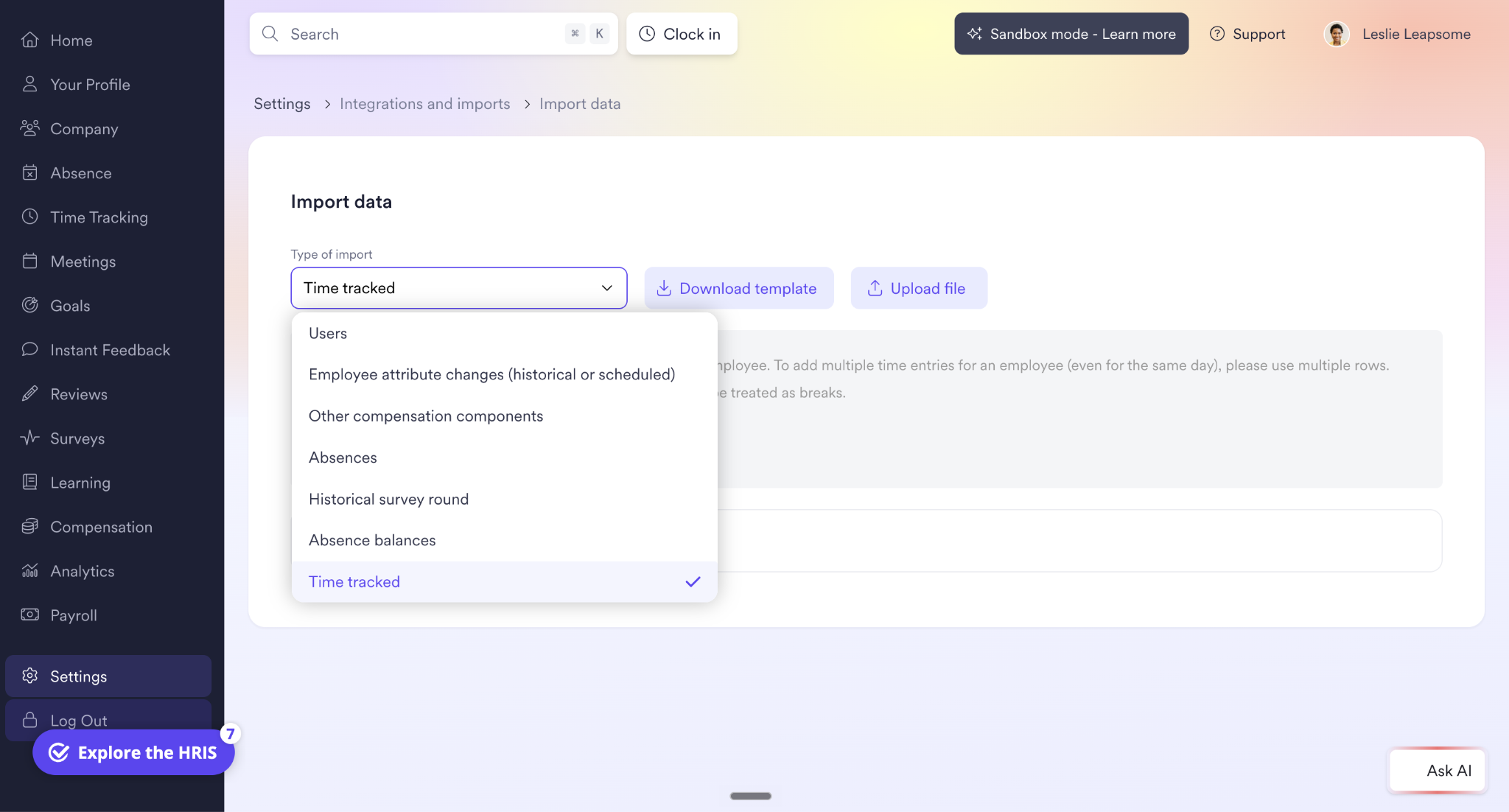
🔗 Connect your tech stack without integration headaches
Leapsome integrates with leading ATS, payroll, and productivity tools, so your data syncs automatically.
👉View Integrations
How Leapsome helps you consolidate your HR tech stack
An all-in-one platform that integrates HRIS, performance, engagement, learning, and compensation simplifies your HR stack. This strategy provides managers and employees with a unified workspace, while reducing the admin burden on HR.
With Leapsome’s all-in-one HRIS and people management platform, you can consolidate by:
- Using the HRIS as your digital HR headquarters: For example, Employee Records act as the foundational layer to capture all data across your stack in real time.
- Creating richer employee-tailored career plans: Tools for reviews, goals, engagement, feedback, and learning all live in a shared space, enabling personalized development.
- Connecting specialist payroll and ATS tools: 100+ built-in integrations, plus custom API setups, let you get your stack fully synced up.
- Getting help with the transition: A dedicated specialist can assist in setting up your HRIS.
"Employees can now find everything in one place — their data, absences, goals, and reviews. I don't have to explain which tool to use for what. It's all in Leapsome." – Marilyn, People Operations at Bob W.
✨ Bring your HR tech stack under control
Leapsome unifies HRIS, performance, engagement, and learning capabilities in one platform, serving as the foundation for your HR tech stack.
👉Request a demo
FAQ
What is the difference between an HR tech stack and an HRIS?
Your tech stack is the ecosystem of tools you use to carry out HR functions. In contrast, an HRIS is a single platform designed to handle core HR needs and centralize employee data. An HRIS is often coupled with specialist platforms for tasks like payroll and hiring.